Scaling AI past the pilot stage comes down to three commitments: leadership funds a prioritized portfolio of use cases, the operating model gets rewired for decision rights and repeatable funding, and governance ships before scale, not after. IMD frames this as an organizational-levers problem, not a technology one, and McKinsey ties outcomes directly to how many employees get pulled into the change. Get those three right and pilots turn into measurable production value; skip any one and you get a demo that never ships.
TL;DR:
- AI scaling requires ownership of use cases, decision rights, and governance to be established early, or pilots will remain unimplemented rather than operational.
- First 90 days focus on confirming leadership sponsorship, selecting a deployment owner, and auditing data sources to prevent delays and maximize progress.
- Prioritization of AI use cases should depend on impact, feasibility, and risk, with legal and compliance involvement during scoring to avoid costly late-stage failures.
- Building an operating model with a high-level sponsor and clear funding is crucial, and models like central, federated, or hybrid teams maximize scaling potential.
- Responsible governance, including oversight committees and clear policies, is essential for safe AI deployment, especially for models influencing high-stakes decisions.
Table of Contents
- What Are the Core Pillars of an AI Adoption Strategy?
- How Do You Identify and Prioritize AI Use Cases?
- Building an Operating Model That Makes AI Repeatable
- Responsible AI and Governance: What Leaders Must Set Before Scaling
- Choosing the Right Technology Path for Each Use Case
- From Pilot to Production: A Roadmap That Actually Scales
- Why Do AI Pilots Fail, and How Do You Fix It Fast?
- How Autonomousfirm Builds AI-Native Capability in Regulated Industries
- Where Leadership Usually Gets AI Adoption Wrong
- Partner With a Build-and-Own Path to Scale AI
- Sources
- FAQ
What Are the Core Pillars of an AI Adoption Strategy?
Five pillars determine whether AI spending turns into results: people, operating model, data, technology, and governance. Each one needs an owner, a first-quarter action, and a metric tied to something the board actually cares about, not a vanity adoption number.
People and change management sits first because tools don’t fail, adoption does. Deploy a “two in the box” pairing of a business owner and a technical lead on every initiative, a structure McKinsey has found reduces the usual tug-of-war between IT and the business units that actually touch the workflow.
Operating model is where most strategies quietly die. Bain & Company has found that the real bottleneck in enterprise AI is rarely model accuracy. It’s who owns the decision to change a process once the model recommends it.
Data, technology, and governance round out the framework, and they move in sequence, not parallel. Microsoft’s Cloud Adoption Framework recommends locking use cases first, then the technology model, then responsible-AI standards, then the data strategy needed to support all three.
Here’s what to do in the first 90 days on each pillar:
- People: Name a change lead and identify 15 to 20 frontline superusers before the first pilot launches.
- Operating model: Decide whether a central team, business units, or a hybrid owns AI delivery, and put a name on the funding decision.
- Data: Audit which three data sources feed your top five candidate use cases, and flag gaps now.
- Technology: Pick one adoption path per use case category instead of evaluating every option for every case.
- Governance: Stand up a lightweight review committee before the first model touches a customer or regulated process.
Pro Tip: Tie each pillar’s KPI to a business outcome the CFO already tracks, cycle time, cost per transaction, error rate, rather than an AI-specific metric nobody outside the project team understands.
How Do You Identify and Prioritize AI Use Cases?
Start with a rapid inventory, not a brainstorm. Pull together frontline staff, domain experts, IT, and legal for a two-week sprint that catalogs every repetitive, rules-heavy, or judgment-assisted task across the business, then sort what you find into three buckets.
- Individual productivity — drafting, summarizing, meeting notes. Low risk, fast to pilot, weak on its own to justify a transformation budget.
- Business process automation — claims triage, underwriting checks, contract review. Higher value, higher data and compliance requirements.
- New revenue or product — AI-native services, embedded advisory tools. Highest upside, longest time to value, and the category where most enterprises overreach first.
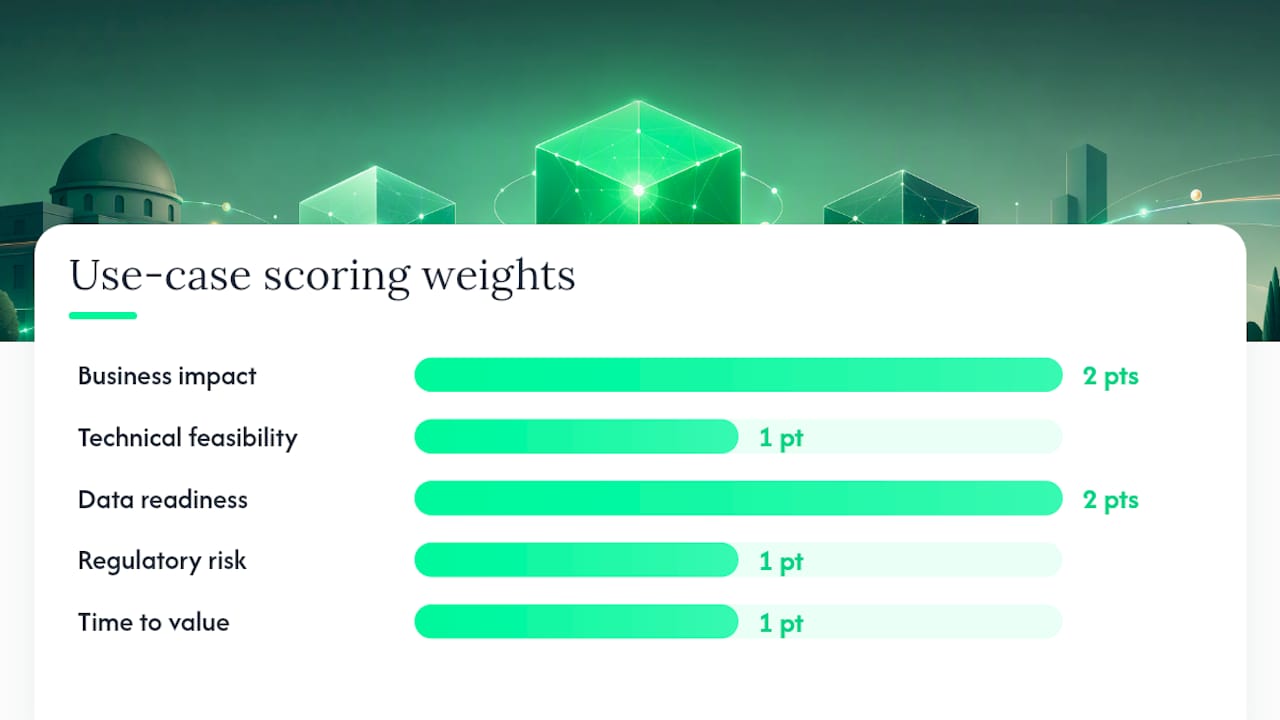
Score every candidate on five factors: business impact, technical feasibility, data readiness, regulatory or reputational risk, and time to value. A simple 1 to 5 rubric across those five factors, weighted so impact and data readiness count double, does more to prevent wasted pilots than any amount of executive enthusiasm.
Involve legal and compliance at scoring time, not after a pilot is already in production. In regulated industries, a use case that scores a 5 on impact but a 1 on data readiness or a 2 on risk should lose to a use case scoring 3s and 4s everywhere. The math sounds unglamorous. It’s also the difference between a pilot that scales and one that quietly disappears from next year’s budget.
Building an Operating Model That Makes AI Repeatable
Ownership has to sit high enough to break ties between business units, and low enough to move fast. Bain’s research on enterprise AI operating models points to a consistent pattern: companies that scale successfully put a C-suite sponsor directly on the hook for portfolio outcomes, rather than delegating the whole effort to a data science team with no budget authority.
Funding needs to move away from the annual-project mindset entirely. IMD makes the case that leaders have to commit capital before full proof exists, which means a portfolio approach where some bets get killed early and others get scaled aggressively. A tool like Betlog illustrates the discipline this requires: tracking which bets paid off and which didn’t, so next year’s funding decisions rest on evidence instead of who argued loudest in the budget meeting.
Three organizational patterns cover most enterprises:
- Central center of excellence (COE): best for organizations early in adoption that need consistent standards and a single point of accountability.
- Federated delivery: business units run their own AI projects against shared standards, works well once several units have already proven capability.
- Hybrid orchestration: a central team sets governance and infrastructure while business units own use-case delivery, the pattern most large regulated enterprises land on eventually.
Deloitte’s research on operating models found a gap between executives who say they’re ready to deploy AI at scale and the operating-model redesign most of them haven’t actually started. That gap is the strategy. Everything else is implementation detail.
Responsible AI and Governance: What Leaders Must Set Before Scaling
Governance isn’t the brake pedal on AI adoption. It’s what lets you press the accelerator without an incident derailing the whole program. Research from Berkeley’s CMR frames ethics and governance spending as value-preserving, not just compliance overhead. It reduces loss exposure, keeps regulators off your back, and builds the internal trust that gets skeptical employees to actually use the tools.
Before any model touches production, put these in place:
- An oversight committee with real authority to pause a deployment, not just review a slide deck after the fact.
- A written acceptable-use policy that names what employees can and can’t do with AI tools, in plain language.
- Model lifecycle controls: version tracking, retraining triggers, and a documented rollback plan.
- Audit logs sufficient to reconstruct any AI-assisted decision months later.
Match human oversight to risk tier. A tool drafting internal meeting summaries needs a light touch. A model influencing a loan decision, a clinical recommendation, or a claims denial needs a human reviewer in the loop and an explanation the affected person can actually understand, not a probability score.
Pro Tip: Publish your acceptable-use policy internally before you publish your first pilot results. Employees trust systems more when the rules of the road exist before the first mistake, not after.
Choosing the Right Technology Path for Each Use Case
Not every use case deserves the same infrastructure investment, and treating a Slack summarization bot with the same rigor as a fraud-detection model wastes both time and money. Microsoft’s Cloud Adoption Framework maps this as a straightforward trade-off between speed and control.
- Prebuilt copilots move fastest and need the least technical talent, but offer minimal customization, a fit for individual-productivity use cases.
- Low-code platforms balance speed with moderate control, good for business-process automation where the logic is well understood.
- Managed platform services (PaaS) trade some speed for stronger data control and integration depth, suited to compliance-heavy workflows.
- Full infrastructure builds take the longest and cost the most upfront, but give complete ownership of the model, the data pipeline, and the audit trail, often the only acceptable choice for regulated financial or healthcare automation.
Before committing to any path, run a technical readiness check: Can the use case actually reach the data it needs? What are the integration points with existing systems? Does your security team sign off on the data flow? Do you have, or can you hire, the talent to maintain what you build? A use case that scored well on the earlier prioritization rubric can still stall here if the infrastructure underneath it isn’t ready. A tool like Vetros is a useful reference point for how companies structure data products before layering AI capability on top.
From Pilot to Production: A Roadmap That Actually Scales
Most pilots fail not because the model underperforms, but because nobody defined what success looked like before launch. Fix that first.
- Design the pilot around a falsifiable hypothesis. State exactly what improves, by how much, and over what sample size, before writing a line of code.
- Build a runbook for evaluation. Define who reviews results, on what cadence, and what threshold triggers a scale decision versus a shutdown.
- Move to staging with monitoring in place. Reliability and cost-per-inference tracking start here, not after full rollout.
- Operationalize with a named owner. Someone inherits this system permanently, it doesn’t get orphaned to whichever team built the prototype.
- Track adoption alongside business impact. Usage numbers without a tie to cost, cycle time, or revenue tell you almost nothing about whether the investment worked.
McKinsey’s research on transformation programs found that involving more than 7% of employees directly in the change effort materially improves the odds of a positive financial outcome. That’s a strong argument for building superuser networks during the pilot phase rather than after scale, when resistance has already hardened.
Watch for failure signals early: adoption that plateaus below expected usage, cost per inference that climbs instead of falling with volume, or a pilot that keeps needing manual exceptions. Any of those three means re-scope the use case before you sink more budget into scaling something that was never going to hold up.

Why Do AI Pilots Fail, and How Do You Fix It Fast?
Four blockers account for most stalled AI programs, and each has a fast, tactical fix rather than a multi-quarter overhaul.
- Skills gap: Pair every pilot team with a superuser from the affected department, not just a data scientist.
- Poor data quality: Fix the data pipeline for one high-value use case before expanding to five mediocre ones.
- Fragmented pilots: Consolidate overlapping pilots under one owner before funding a sixth parallel experiment.
- Risk aversion: Bring legal and compliance into the design phase, not the launch-approval phase.
A pilot needs re-scoping, not shutdown, when the core hypothesis still holds but the data or integration path was wrong. Shut it down when the underlying business case no longer makes sense even with perfect execution. Reducing employee resistance usually comes down to one thing: let the people doing the work help design the tool that replaces part of their task, not the vendor.
How Autonomousfirm Builds AI-Native Capability in Regulated Industries
Regulated industries can’t bolt AI onto legacy systems and call it a strategy. Finance, healthcare, insurance, and legal operations need compliance, data sovereignty, and audit trails built into the system from day one, not retrofitted after a regulator asks questions. Forbes Tech Council frames this as building a persistent capability rather than chasing one-off projects, and that’s the model Autonomousfirm builds toward with clients.
Three things distinguish this approach from buying another SaaS subscription:
- Ownership, not rental. Clients own the complete system and the IP behind it, rather than renting access to a vendor’s black box.
- Proprietary knowledge transfer. The build process is designed to move domain expertise into the software itself, so the system encodes what your best people already know.
- Compliance-first architecture. Security, audit logging, and data control are engineered into the platform from the start, not added as an afterthought.
Leaders ready to move past pilots can request a readiness assessment, scope a focused co-build engagement, or start with a single high-priority use case identified through the Autonomousfirm platform.
Where Leadership Usually Gets AI Adoption Wrong
The most common mistake isn’t underfunding AI. It’s treating it as a point solution: buy a tool, plug it into one workflow, declare victory. That framing guarantees a portfolio of disconnected pilots that never talk to each other and never compound in value.
The fix is treating AI as an ongoing capability with a named owner, a funding line that survives past the pilot budget, and a governance structure that scales with it. Leaders who make that shift stop asking “which tool should we buy” and start asking “what decision rights need to change.” That’s a harder question, and it’s the one that actually determines whether AI adoption strategy becomes a durable advantage or a slide deck from two years ago.
— Matevz
Partner With a Build-and-Own Path to Scale AI
Most AI adoption strategies stall because leaders are choosing between two bad options: rent another point tool, or hire a full internal engineering team from scratch. A third path built specifically for regulated industries is offered: a technical partner who builds the complete system with you, transfers the knowledge into your team, and provides ownership of the IP, the data, and the audit trail when it’s done.
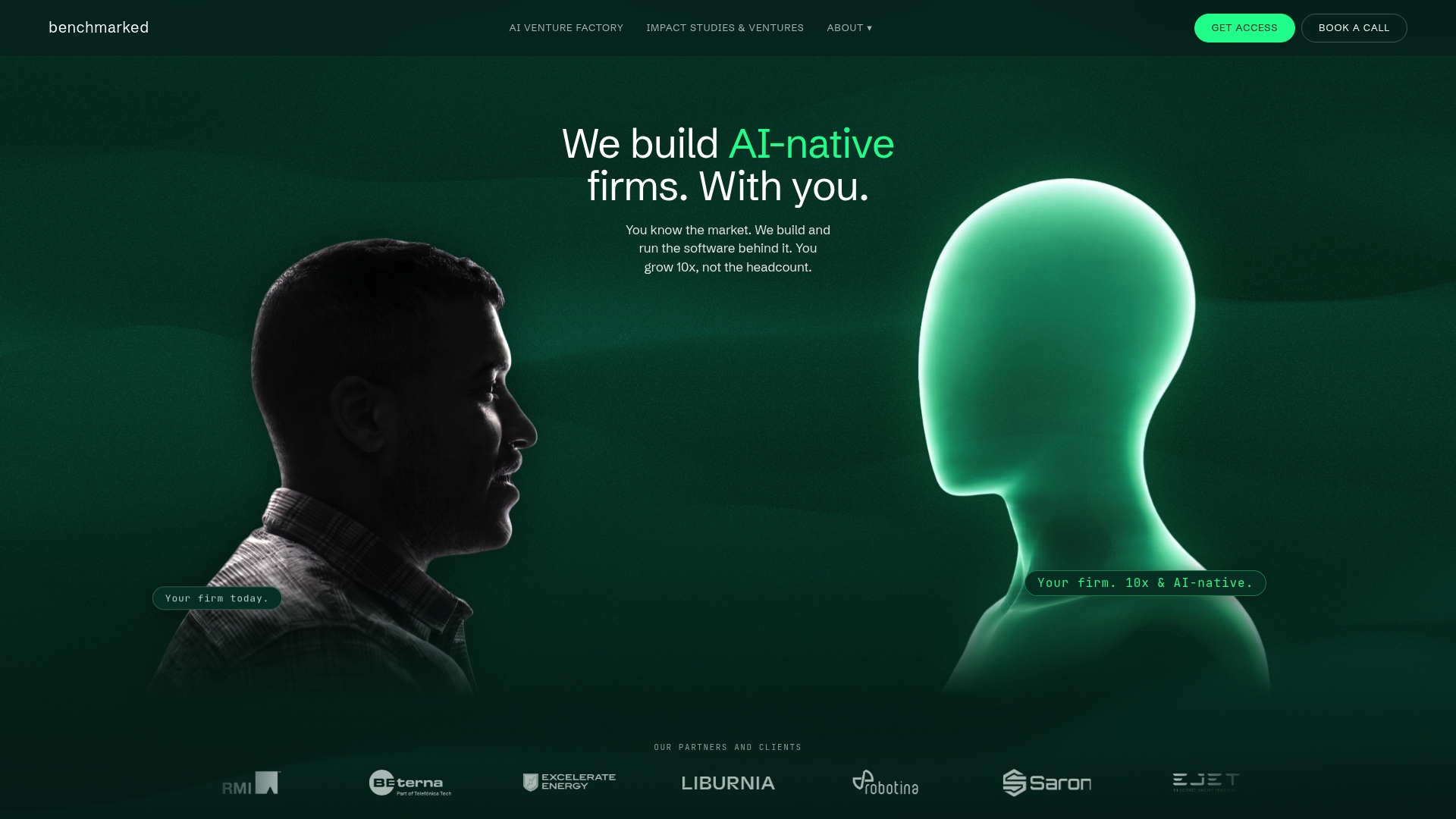
That ownership model matters most in finance, healthcare, insurance, and legal operations, where renting a black-box tool creates a compliance liability you can’t fully control. Some build-and-partner engagements are designed around principles such as prioritized use cases, compliance-first architecture, and a knowledge-transfer process that helps your team run and extend the system without permanent dependency on outside vendors. This model is often used to grow operational capacity without adding headcount, because the system handles repeatable work while people manage the judgment calls that still need a human.
If your organization has a high-priority use case that’s stalled on data readiness, compliance risk, or a lack of internal engineering bandwidth, request an assessment through Autonomousfirm or explore a co-build engagement to scope your first production system.
Sources
- AI strategy is a journey. These are the levers that matter. — IMD
- AI strategy - Guidance to set your organization’s AI strategy — Microsoft Learn
FAQ
What Is the 30% Rule in AI?
There’s no single, universally recognized “30% rule” in AI strategy literature; the phrase is used inconsistently across sources, sometimes describing productivity gains and sometimes adoption thresholds, so treat any specific figure you encounter with caution and verify it against a primary source before citing it.
What Is the Failure Rate of AI Adoption Projects?
Failure rates vary widely by industry and definition of “failure,” but research from firms like Bain and Deloitte consistently points to operating-model gaps, not model accuracy, as the primary driver behind stalled or abandoned pilots.
What Is the 10/20/70 Rule for AI?
The concept generally describes AI transformation effort as roughly 10% algorithms, 20% technology and data infrastructure, and 70% people and process change, a framing consistent with McKinsey’s emphasis on broad employee involvement driving adoption outcomes.
Which Country Is Leading in AI Adoption?
Adoption leadership shifts by sector and metric, and no single country holds a uniform lead across enterprise AI adoption; leaders should focus less on national rankings and more on the operating-model and governance practices proven to drive results inside their own regulatory environment.
How Long Does It Take to Scale an AI Pilot to Production?
Timelines vary by use case complexity and regulatory requirements, but most successful programs move from a scoped pilot to staged production within two to three quarters, provided governance and data readiness were addressed before the pilot started rather than after.