Medical billing automation uses AI and rules-based software to code, scrub, submit, and post claims with minimal manual touch. The main outcome is fewer clean-claim rejections and faster reimbursement, not the elimination of your billing staff. AI is the technology driving most of the recent gains, but it works best paired with human review on exceptions, not as a full replacement for judgment.
TL;DR:
- Automation reduces claim errors by catching formatting and coverage issues before submission, leading to fewer first-pass rejections.
- AI models predict denial likelihood using historical data, but human review remains necessary for complex or unusual coding scenarios.
- Implementation success depends on careful pilot testing, integration with existing systems, and ongoing validation to prevent accuracy drift.
- Faster remittance posting and verification cut days in accounts receivable, but staffing shifts focus staff from routine coding to complex appeals and negotiations.
- Fully compliant systems are built with robust audit trails, explainability, and strict data governance, crucial for regulated healthcare billing environments.
Table of Contents
- What Does Medical Billing Automation Actually Cover?
- What Results Should You Expect From Automation?
- How Do AI and Automation Actually Work Under the Hood?
- How Do You Choose the Right Automation Approach?
- What Does a Realistic Implementation Timeline Look Like?
- How Do You Keep Automation Compliant After Go-Live?
- What Do Real-World Automation Results Look Like?
- Who Should Pilot This Now, and What Comes Next?
- Why Compliance-First Automation Beats the “Set It and Forget It” Pitch
- Ready to Own Your Billing Automation Instead of Renting It?
- Where to Verify the Compliance and Technical Details
- Sources
- FAQ
What Does Medical Billing Automation Actually Cover?
Medical billing automation isn’t one tool doing one job. It’s a chain of tasks, and each link can be automated to a different degree depending on your specialty, payer mix, and risk tolerance.
The most commonly automated steps are coding suggestions, claim scrubbing against payer rules, eligibility verification, electronic submission, payment posting from remittance files, and initial denial triage. A dermatology practice might automate a large portion of coding for routine visits; a multi-specialty group with complex modifiers will lean more on human coders reviewing AI suggestions before submission.
There’s a real difference between classical rule-based automation and AI-enabled workflows, and administrators often conflate the two. Rule-based systems apply static logic: if a code pairs with a modifier the payer rejects, flag it. That’s been standard in claim scrubbers for over a decade. AI-enabled systems go further, using natural language processing to read clinical notes and suggest codes, and machine learning models to predict which claims are likely to deny before they’re even submitted. A 2025 review of AI in automated billing found that the technology can reduce billing errors and expedite authorizations, though it stressed that oversight remains necessary.
Where humans stay essential: complex appeals, unusual coding scenarios not well represented in training data, payer-specific quirks that change faster than models get retrained, and anything touching medical necessity judgment calls. No automation vendor credibly claims to remove that layer entirely, and any that does should raise a flag during evaluation.
What Results Should You Expect From Automation?
The numbers that matter to a CFO or practice administrator aren’t abstract efficiency claims. They’re first-pass clean claim rates, days in A/R, and staff hours freed for higher-value work.
Automated scrubbing catches formatting errors, missing modifiers, and payer-specific rule violations before submission, which is where most denials originate. Combined with AI-based denial prediction, practices typically see fewer claims bounce back on the first submission, cutting the rework cycle that eats into billing staff time. University research on AI in billing points to improved accuracy and efficiency as the consistent, repeatable gain across implementations, even as it cautions that workforce and limitation issues need active management rather than a set-and-forget approach.
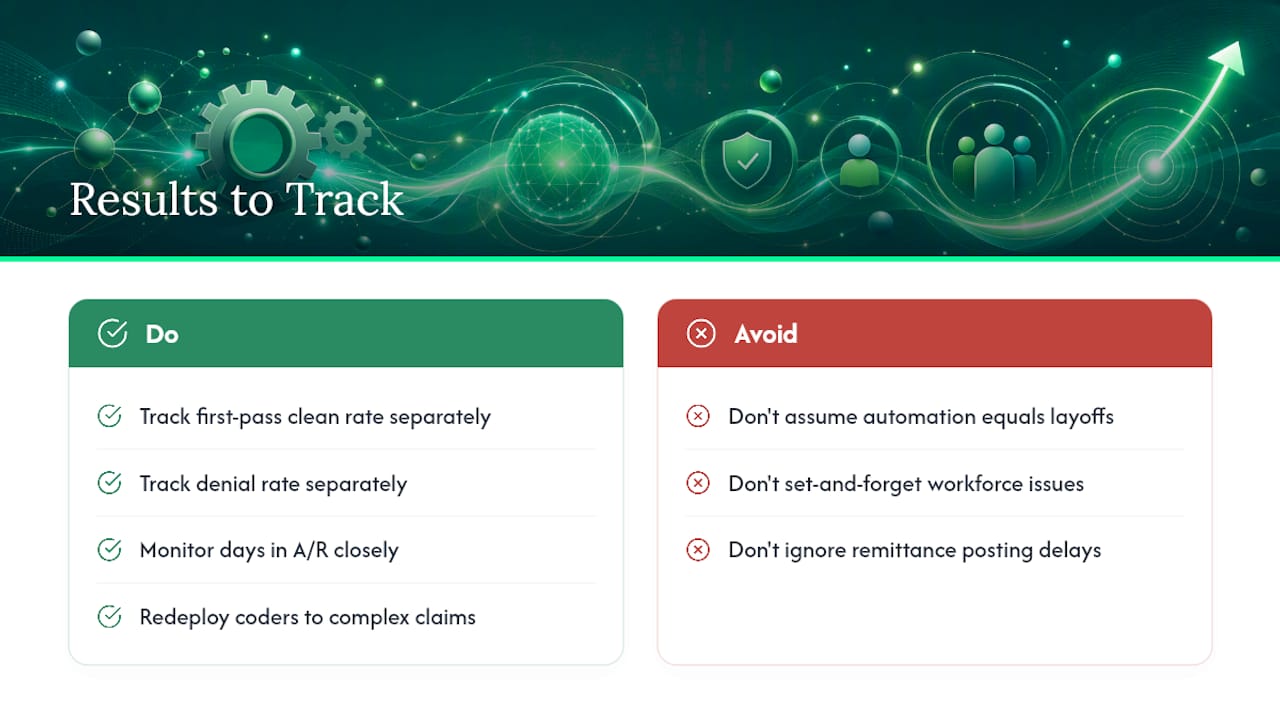
Pro Tip: Track first-pass clean claim rate and denial rate separately. A practice can improve one while the other stays flat if scrubbing catches format errors but the coding logic underneath is still wrong.
Days in A/R is the second metric worth watching closely. Faster claim submission and quicker remittance posting compress the time between service delivery and cash in the bank. Vendor-reported data from automated remittance handling shows EOB-to-835 conversion can strip out large chunks of manual data entry, which is where posting delays typically hide.
Staffing impact is the part administrators underestimate. Automation rarely means layoffs in a well-run rollout. It means your coders spend less time on routine E/M visits and more time on complex claims, appeals, and payer relationship management, which is where their expertise actually pays off. RAND’s workforce research frames this staffing pressure as a systemic issue across health care operations, not something unique to any one practice’s billing department.
How Do AI and Automation Actually Work Under the Hood?
Most automated billing platforms combine several distinct technical components, and understanding what each one does helps you evaluate vendor claims instead of taking marketing copy at face value.
Natural language processing extracts relevant clinical details from provider notes, whether typed, dictated, or structured EHR fields, and maps them to candidate codes. This is the auto-coding layer, and it’s rarely a single model. Most serious platforms hybridize a deterministic rule engine (payer-specific logic, NCCI edits, LCD/NCD coverage rules) with a machine learning layer that handles pattern recognition across historical claims. Agentic AI platforms describe this pairing explicitly, using confidence thresholds and human-in-the-loop gating so low-confidence predictions route to a person instead of auto-submitting.
Claim scrubbing engines run against payer rule sets before submission, catching the kind of errors that trigger automatic denials: mismatched modifiers, expired authorizations, eligibility gaps. Denial-prediction models take this further by scoring a claim’s likelihood of rejection before it ever leaves the building, based on patterns learned from your own historical denial data.
Integration is where automation lives or dies operationally. Your EHR needs to exchange data through HL7 or FHIR standards for clinical documentation to flow into the billing engine without manual re-entry. Clearinghouse connections handle the submission and status-tracking layer. Eligibility checks run through the 270/271 transaction set, verifying coverage before the appointment even happens. Remittance processing reads 835 files to auto-post payments and flag underpayments.
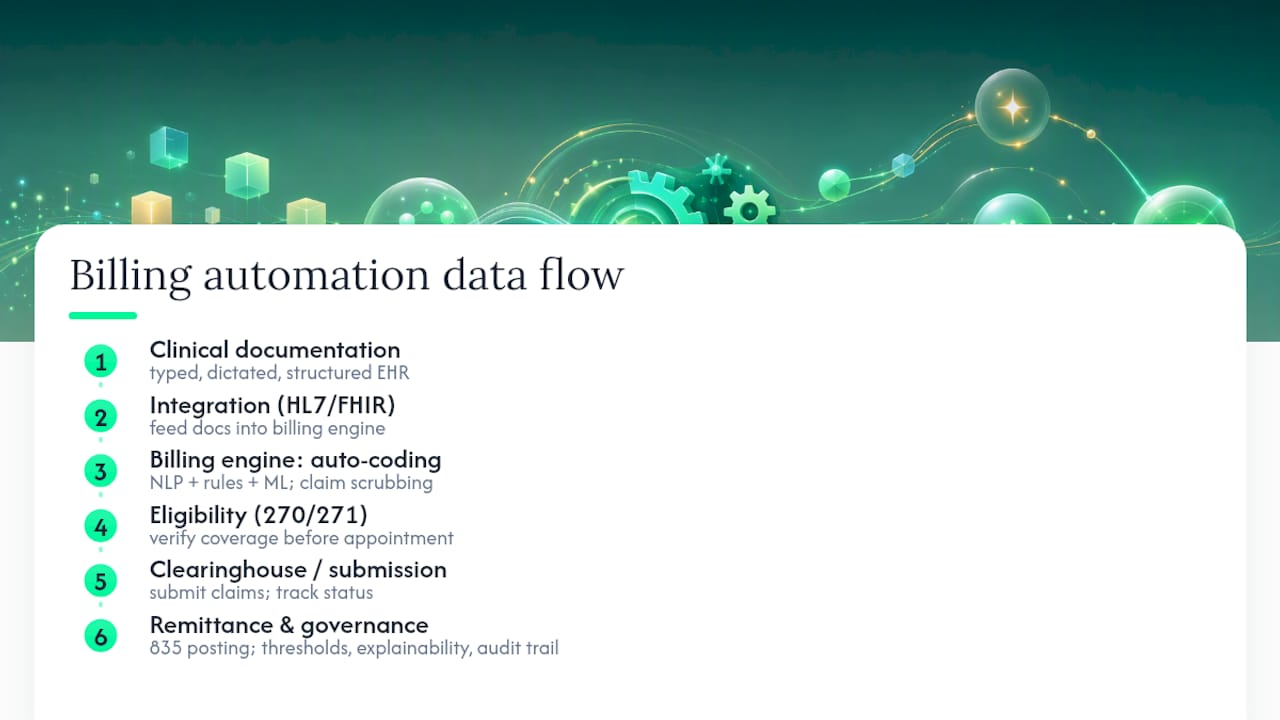
None of this works safely without governance. Confidence thresholds decide which claims auto-submit versus route for review. Explainability, meaning the system can show why it suggested a code, matters both for coder trust and for audit defense. A full audit trail, timestamped and immutable, is what turns “the AI did it” into a defensible record during a payer audit or compliance review. Peer-reviewed clinical informatics literature flags auditability and PHI handling as recurring implementation concerns worth building into any evaluation checklist from day one.
How Do You Choose the Right Automation Approach?
Vendor selection in this space is less about feature checklists and more about fit, because a platform tuned for high-volume primary care claims will underperform on a specialty with unusual coding patterns.
Start with integration requirements. Confirm the platform connects to your specific EHR, your clearinghouse, and can ingest ERA/835 feeds without a custom build. Ask for a specialty and payer-fit test using your own historical claims data, not a generic demo, since accuracy claims built on someone else’s claim mix mean very little for your denial patterns.
Governance deserves equal weight in the evaluation. Who signs off on AI-suggested codes before submission? Does the platform produce an audit trail detailed enough to survive a payer audit? Can a coder trace back why the system flagged or approved a specific claim? Explainability isn’t a nice-to-have here, it’s what lets your compliance officer sleep at night.
Security and compliance sit underneath everything else. Confirm a signed business associate agreement is standard, not an upsell, and that the vendor can point to HIPAA-aligned safeguards for PHI in transit and at rest. SOC 2 attestation and clear data residency terms matter more once you’re moving claims data through a third-party model. If the platform integrates with an electronic health record system, review how that connection handles clinical data governance, since EHR-level record management practices affect how cleanly billing data flows downstream.
On cost, expect a mix of pricing models: per-claim fees, percentage-of-collections, flat subscription tiers, or hybrid structures with implementation costs upfront. Build a total cost of ownership view that includes onboarding, training time, and the cost of running a parallel legacy process during transition, not just the sticker price.
Key evaluation checklist:
- Confirm EHR, clearinghouse, and 835/270 integration compatibility before any contract discussion
- Request a fit test on your own historical claims, not a generic demo
- Verify audit trail depth and explainability for every auto-coded claim
- Get a signed BAA and ask directly about SOC 2 status and data residency
- Model total cost of ownership, not just the headline subscription price
- Decide build versus buy based on whether billing is core to your competitive position or a cost center you want off your plate
Build versus buy comes down to one honest question: does owning the system give you a durable advantage, or is billing automation simply infrastructure you need running reliably in the background? Larger health systems increasingly weigh owning their automation stack outright, since a licensed platform tied to a vendor’s roadmap can limit how deeply it integrates with proprietary clinical workflows over time.
What Does a Realistic Implementation Timeline Look Like?
Rushing a full-scale rollout is the single most common mistake in automation projects, and it’s almost always avoidable with a properly scoped pilot.
- Design a focused pilot. Pick one specialty, one or two payers, and a defined claim volume. Set explicit success metrics before you start, typically first-pass clean claim rate, denial rate, and average days in A/R, and know your baseline numbers for each.
- Map your data and integrations. Confirm HL7/FHIR connectivity to your EHR, clearinghouse credentials, and 835 remittance feed setup happens before go-live, not during it.
- Run parallel validation. Process the same claims through both the legacy workflow and the new system for a defined period, comparing outputs line by line before trusting automated output alone.
- Train staff and design exception workflows. Define exactly who reviews low-confidence AI suggestions, what the escalation path looks like, and how coders sign off on flagged claims.
- Apply go/no-go gates. Set a minimum confidence and accuracy threshold the pilot must hit before scaling to additional payers or specialties. Successful pilots tie the go-live decision to these thresholds rather than a fixed calendar date.
- Scale in stages. Add specialties or payer groups incrementally, repeating the validation step at each stage rather than expanding everywhere at once.
Most well-run pilots run a few months before a scale decision, though claim volume and payer complexity affect the timeline.
How Do You Keep Automation Compliant After Go-Live?
Launch day isn’t the finish line. Automation that isn’t monitored drifts, and drift in a regulated billing environment turns into denials or compliance exposure fast.
Set clear exception triage SLAs: how quickly must a flagged claim get human review, and who owns escalation when a coder disagrees with an AI suggestion? Build monitoring dashboards tracking first-pass clean claim rate, denial rate by payer, and days in A/R weekly, not quarterly, since small drifts compound.
Every model update or rule-set change needs regression testing against a known claim sample before it goes live. This is the step teams skip when they’re moving fast, and it’s exactly where accuracy quietly degrades. Schedule periodic compliance audits reviewing a sample of auto-coded claims against documentation, independent of your vendor’s own quality reporting.
Staff roles shift permanently after automation matures. Coders move from high-volume routine coding toward exception handling, denial appeals, and payer negotiation. Budget for re-skilling rather than assuming the same job descriptions still apply a year in.
What Do Real-World Automation Results Look Like?
Two anonymized scenarios illustrate the range of outcomes practices typically report, drawn from patterns consistent with published implementation data rather than any single named client.
A mid-size multi-specialty group struggling with a denial rate above industry norms piloted automated claim scrubbing and AI-assisted coding on its highest-volume specialty first. Baseline first-pass clean claims were weak, with a meaningful share of claims bouncing on preventable formatting and modifier errors. After a 90-day pilot with parallel validation, the group reported measurably fewer denials tied to those preventable errors and a shortened A/R cycle, driven largely by faster remittance posting once 835 files were processed automatically instead of manually keyed.
A specialty surgical practice took a narrower approach, automating only eligibility verification and remittance posting while keeping coding fully manual due to the complexity of its procedure mix. The result was a faster cash-collection cycle without touching the coding workflow at all, proving that automation doesn’t require an all-or-nothing rollout to deliver measurable value.
The consistent thread across both cases: the practices that saw the cleanest results started with a narrow, measurable pilot rather than a full department overhaul, and they kept a human sign-off step on anything flagged as low-confidence.
The lesson worth replicating is discipline in scope. Automate the highest-friction step first, measure against a real baseline, and expand only once the numbers hold up under parallel validation.
Who Should Pilot This Now, and What Comes Next?
Practices with high claim volume, a denial rate above their specialty benchmark, or billing staff buried in rework are the clearest candidates to move now. Smaller practices with low volume may see a longer payback horizon relative to implementation cost.
Expect meaningful ROI within two to three billing cycles once a pilot clears validation, not on day one. The trade-off is real: faster claims processing in exchange for upfront integration work and a disciplined pilot phase.
Three next steps: pull 90 days of denial data as your baseline, identify one specialty or payer group for a pilot, and confirm governance, meaning who signs off on AI-coded claims, before signing anything.
Why Compliance-First Automation Beats the “Set It and Forget It” Pitch
Most vendors selling into health care pitch automation as a plug-and-play fix: connect the system, watch denials drop, move on. That framing undersells the real risk, which isn’t whether the AI can code a claim correctly most of the time. It’s what happens on the claims it gets wrong, and whether your organization can prove, during an audit, exactly why a code was submitted.
Some vendors build AI-native systems for regulated industries with that risk as the starting design constraint, not an afterthought bolted on later. Compliance and audit trails get built into the architecture before the first claim is processed, and clients own the resulting system outright rather than renting access to a vendor’s black box. That distinction matters more in health care billing than almost anywhere else, because owning the system means owning the audit trail, the data, and the ability to adapt the logic as payer rules shift, instead of waiting on a vendor’s release cycle.
The practices getting this right treat automation as infrastructure they control, not a subscription they hope keeps working.
— Matevz
Ready to Own Your Billing Automation Instead of Renting It?
Some companies offer custom AI-native billing systems for health care organizations that want to own the platform outright, not lease a black-box tool with a monthly invoice attached. This approach means the compliance framework, the audit trail, and the coding logic are built around the specific payer mix and specialty from day one, with a signed BAA and HIPAA-aligned data controls included in the architecture rather than added as an afterthought.

The build-and-own model matters because payer rules and specialty coding patterns shift constantly, and a system controlled by the organization can adapt on its own timeline instead of waiting for a vendor’s roadmap. If your team is evaluating automation and wants a system designed around your actual claims data rather than a generic demo, start a conversation with Autonomousfirm about what a compliance-first build looks like for your billing operation.
Where to Verify the Compliance and Technical Details
- HIPAA privacy and security requirements: the HHS HIPAA guidance for professionals covers safeguards and business associate agreement obligations for any vendor handling PHI.
- Peer-reviewed evidence on AI in billing: the global and Saudi perspective review on automated medical billing with AI covers both capabilities and implementation limits.
- Educational perspective on workforce impact: UTSA’s overview of AI in medical billing and coding covers efficiency gains alongside the staffing considerations administrators need to plan for.
This article is general information, not a substitute for advice from a qualified financial advisor. Consult a qualified financial professional about your own circumstances before acting on anything here.
Sources
- Hhs
- The Evolution of Automated Medical Billing With Artificial Intelligence: A Review With a Global and Saudi Perspective
- How AI is Revolutionizing Medical Billing and Coding | UTSA PACE
FAQ
Can medical billing be fully automated?
No. Coding, scrubbing, eligibility checks, and remittance posting can be largely automated, but complex appeals, unusual coding scenarios, and medical necessity judgment calls still need human review.
Is AI replacing medical billers?
Not in practice. AI shifts billers away from routine coding toward exception handling, denial appeals, and payer negotiation, and most well-run rollouts redeploy staff rather than eliminate roles.
Who typically earns more, a medical biller or a medical coder?
Certified medical coders generally earn more than general billers, since coding requires specialized certification and carries greater compliance responsibility, though pay varies widely by region, specialty, and experience.
Can I teach myself medical billing and coding?
Yes, though most people pursuing it professionally pair self-study with a certification program, since payers and employers typically expect a recognized credential rather than self-taught knowledge alone.
How does automated claim scrubbing reduce denials?
Scrubbing engines check claims against payer-specific rules, such as modifier pairings and coverage edits, before submission, catching the formatting and eligibility errors that cause most first-pass denials.


