Yes, medical coding automation works today for a defined slice of encounters, and it works well enough to change how a coding department runs. Peer-reviewed models now hit AUCs of 0.94 to 0.95 on tasks like emergency department level prediction, automation rates concentrate in routine, well-documented visits, and the payoff shows up in shorter billing cycles and lower error rates. The catch is that none of it functions without clean data pipelines, confidence thresholds, and a governance layer that can produce an audit trail on demand.
TL;DR:
- Medical coding automation currently achieves high accuracy on specific tasks like emergency department billing levels, with AUCs of 0.94 to 0.95 and CPT accuracy up to 95 percent on focused subsets.
- Automation rates are higher in routine, well-documented visits, but achieving full coverage requires high-quality, clean data pipelines, strict governance, and confidence thresholds to ensure compliance.
- The most effective implementations pick a narrow pilot scope, prepare data carefully, and run shadow modes before gradually moving to live coding with ongoing monitoring and coder oversight.
- Organizations owning their systems can ensure better auditability and compliance. Building a tailored, fully own system is feasible and offers more control than subscription-based models.
- Automation complements human coders by handling routine tasks, freeing staff for exception management, audits, and complex cases, rather than replacing their roles entirely.
Table of Contents
- What Is Medical Coding Automation, Exactly?
- How Does AI Actually Map to Coding Tasks?
- What Do Accuracy Benchmarks Actually Show?
- How Do You Pilot and Scale Coding Automation?
- What Do EHR Integration and Data Pipelines Require?
- What Governance and Compliance Controls Are Required?
- How Do You Evaluate a Coding Automation Approach?
- How Autonomousfirm Builds Owned Coding Automation
- Who Should Move on This Now, and Who Should Wait?
- Build Coding Automation You Actually Own
- Sources
- FAQ
What Is Medical Coding Automation, Exactly?
Medical coding automation refers to software that reads clinical documentation and assigns billing and diagnostic codes, ICD-10, CPT, and DRG, without a human coder typing them in from scratch. The industry uses a few overlapping terms for this, and they are not quite interchangeable.
Computer-assisted coding (CAC) suggests codes to a human coder, who reviews and confirms them. Autonomous coding goes further: the system finalizes codes for a subset of encounters with no human touch, routing anything uncertain to a coder for review. Automated clinical coding is the broader academic term covering both, and it is the phrase you will see most often in the research literature, including a widely cited review of automated clinical coding approaches that frames the field’s promise and its unresolved problems.
Where this fits in the revenue cycle depends on the use case:
- Billing-focused coding targets ICD-10, CPT, and DRG assignment for claims submission, the highest-volume and most commercially mature application.
- Risk adjustment (RADV) coding supports Medicare Advantage and value-based contracts, where accuracy under audit matters more than raw speed.
- Research and phenotyping uses coding output to build cohorts for clinical studies or population health analytics, tolerating more noise in exchange for scale.
Deployment mode matters just as much as use case. Concurrent coding happens while the patient is still in the encounter or shortly after discharge, feeding same-day billing. Retrospective coding runs against closed charts in batches, often overnight, and is where most autonomous coding pilots start because the stakes of a delay are lower. Any credible medical coding automation program picks one deployment mode and one use case first. Trying to automate risk adjustment and same-day ED billing in the same pilot is how projects stall.
How Does AI Actually Map to Coding Tasks?
Coding is not one machine learning problem. It is several, and picking the wrong framing is a common reason automation initiatives underdeliver.
Multi-label classification treats each chart as an input and each possible code as a label the model can turn on or off. This works reasonably well for CPT and DRG assignment, where the universe of plausible codes for a given specialty is bounded and codes often travel in predictable clusters, a knee arthroscopy visit reliably produces a narrow set of CPT possibilities. The limitation shows up with ICD-10, which has more than 70,000 codes; a flat classification approach either underperforms on rare codes or requires enormous labeled datasets to cover the long tail.
Named entity recognition (NER) plus linking takes a different route. The model first identifies clinical concepts in free text, a lesion, a medication, a lab value, then links each entity to a coding ontology such as SNOMED CT or ICD-10-CM. This handles rare and compound conditions better because it does not need to have seen that exact code combination during training. It also produces something classification alone does not: a pointer back to the exact sentence that justified the code, which becomes critical for audit defense later.
Most production systems now run on transformer architectures, BERT variants and XLNet-based models most commonly, sometimes as ensembles rather than single models. One representative study found an XLNet-based model generating CPT predictions with class-wise accuracy up to 88 to 95 percent on focused subsets, and separate ensemble models predicting emergency department billing levels reached an AUC of 0.94 to 0.95. Those numbers describe strong pattern-matching, not clinical judgment, which is exactly why ensembles tend to outperform single models: different architectures make different mistakes, and averaging their outputs smooths out some of the noise.
None of this works safely on its own. A rules layer, encoding payer-specific requirements, National Correct Coding Initiative edits, and specialty-specific documentation standards, sits on top of the ML output and either confirms or overrides it. Confidence scoring determines whether a code gets auto-finalized or routed to a human. Reviewers at the PMC review on automated clinical coding argue that knowledge-augmented deep learning, blending ontology hierarchies with the neural network rather than relying on raw text patterns alone, improves both explainability and performance on rare, few-shot codes that pure ML struggles with.

The practical takeaway for a technology decision-maker: a pure end-to-end neural model without a rules layer is not compliance-ready, no matter how good its accuracy numbers look in a research paper. A hybrid approach, ML for pattern recognition, rules and ontologies for compliance and edge cases, is the only version of this that survives a payer audit.
What Do Accuracy Benchmarks Actually Show?
The honest answer is that accuracy varies enormously by task, specialty, and how narrowly “accuracy” gets defined, and vendors do not always define it the same way.
The numbers that matter: Ensemble models predicting emergency department billing levels have reached an AUC of 0.94 to 0.95, and XLNet-based CPT prediction models have hit class-wise accuracy up to 88 to 95 percent on focused subsets. These are strong numbers for a narrow task, not a guarantee across every specialty or note type.
Automation rate is a different metric from accuracy, and conflating them is a common mistake. Accuracy asks: when the model assigns a code, how often is it correct? Automation rate, sometimes called the “qualified for automation” rate in vendor materials, asks: what percentage of encounters can the system finalize without any human touch at all? A model can be 95 percent accurate on the codes it assigns while only qualifying 40 percent of encounters for full automation, because the rest trigger a low-confidence flag. Vendor materials for autonomous coding platforms, including production deployments like Solventum’s 360 Encompass system, report facility-level metrics measured in millions of processed encounters with median coding speeds in the seconds, alongside qualified automation rates that vary by care setting. Emergency medicine and routine outpatient visits tend to automate at higher rates than complex inpatient stays with multiple comorbidities.
Dataset and setting caveats matter more here than in most machine learning applications. A model trained on English-language notes from a large academic medical center will not transfer cleanly to a rural clinic with different documentation habits, a different EHR template, or a different specialty mix. Roughly 80 percent of medical records consist of unstructured free text rather than structured fields, and the quality of that free text, shorthand, copy-forward errors, inconsistent templates, drives model performance more than the underlying architecture does.
Operationally, accuracy determines how much human review load the system removes. A system automating 50 percent of encounters at 92 percent accuracy still leaves coders reviewing the other half plus auditing a slice of the automated half for quality assurance. The realistic near-term expectation for most organizations is a meaningful reduction in coder workload on routine encounters, not full displacement, and that reduction is what improves both billing cycle time and revenue capture by getting claims out the door faster.
How Do You Pilot and Scale Coding Automation?
Running this well is a sequencing problem more than a technology problem. Organizations that get burned on automation pilots almost always skipped a step rather than picked the wrong model.
- Pick a narrow pilot scope. Choose one care setting (emergency medicine, routine outpatient visits, a single specialty) and one deployment mode. Define success metrics up front: target automation percentage, precision and recall thresholds by code category, and expected throughput per day.
- Prepare the data before touching a model. Extract structured and unstructured notes from the EHR, de-duplicate copy-forward text that inflates note length without adding information, and build a labeling process with dual review for the training set. Privacy controls, de-identification for any data leaving a secure environment, need to be built into this step, not bolted on afterward.
- Run shadow mode first. The system generates codes but does not submit anything; a human coder codes independently, and the two outputs get compared. This is where you learn the model’s real accuracy on your documentation style, not the vendor’s demo dataset.
- Move to dual-coding with adjudication. The system’s codes go live, but a coder reviews every one for a defined period, and disagreements get adjudicated by a senior coder or coding manager. This surfaces systematic errors, a specific denial pattern, a specialty the model handles poorly, before they hit claims at scale.
- Set continuous monitoring before removing human review. Track automation rate, accuracy against post-payment audit results, and denial rate by code category on an ongoing basis, not just during the pilot window.
- Scale with a QA sampling plan, not full manual review. Define an SLA for turnaround time, build automated QA sampling (reviewing a statistically meaningful slice of auto-coded claims rather than all of them), and set a retraining cadence tied to documentation changes, new CPT codes, or drift in denial patterns.
Pro Tip: Budget your pilot timeline in months, not weeks. Shadow mode alone typically needs four to eight weeks of volume to generate a statistically useful comparison, and rushing this step is the single most common reason organizations relaunch a “failed” pilot a year later with the same vendor.
Coder roles change through this process rather than disappearing. Coders shift from first-pass coding on every chart toward exception handling, auditing the automated output, and managing the edge cases the model routes to them. That shift needs to be named explicitly in change management, because coders who hear “automation” and assume “layoffs” will not engage honestly with a shadow-mode pilot that depends on their careful comparison work.
What Do EHR Integration and Data Pipelines Require?
The engineering work behind medical coding automation is less about the model and more about getting clean data to it reliably, on time, every time.
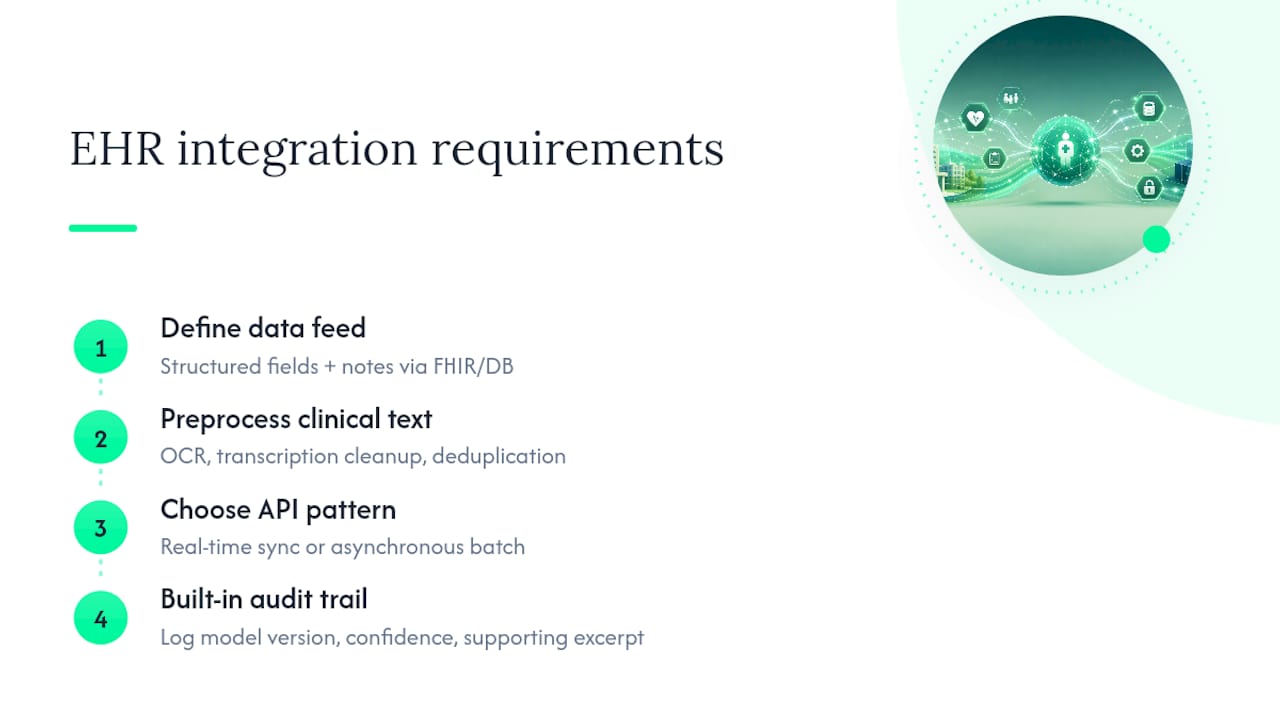
Every deployment needs a defined data feed from the EHR: structured fields (demographics, orders, lab results) and unstructured clinical notes, typically pulled via HL7 FHIR APIs or a direct database extract depending on the EHR vendor and IT governance policies. Because most of the clinically relevant coding detail lives in free text, the pipeline has to handle OCR for scanned documents, transcription cleanup for dictated notes, and de-duplication logic that strips repeated copy-forward boilerplate before it reaches the model. Skipping de-duplication is a common early mistake. A note padded with three days of unchanged assessment text does not just waste processing time, it actively confuses models trained to weight recent, specific documentation over repeated filler.
API architecture depends on the deployment mode chosen earlier. Concurrent coding, feeding same-day billing, generally needs a synchronous or near-real-time API pattern with tight latency budgets, since a slow response holds up the clinical workflow it is embedded in. Retrospective batch coding can run asynchronously overnight against closed charts, which gives more flexibility on batch size and lets the system prioritize throughput over per-request latency.
Every architecture, regardless of mode, needs a built-in audit trail: which model version processed the chart, what confidence score it assigned, what text excerpt supported each code. This is not optional infrastructure to add later. Retrofitting audit logging into a system that was not designed for it is expensive and often requires reprocessing historical claims to backfill the missing evidence trail.
What Governance and Compliance Controls Are Required?
Payers and regulators do not accept “the model said so” as justification for a code. Every automated coding system needs a governance layer built to survive an audit, not just a technical one built to pass a benchmark.
- Confidence thresholds with exception routing. Set a minimum confidence score below which a code routes automatically to a human coder rather than auto-finalizing, and calibrate that threshold per code category since rare codes typically need a higher bar.
- Traceable audit evidence. Every automated code should carry the source text excerpt that justified it, the rule or model logic applied, and a timestamp, the same pattern illustrated in production tools like Corti’s medical coding platform, which returns evidence excerpts and written justifications alongside each suggested code.
- Drift monitoring. Track model performance against post-payment audit outcomes on a rolling basis, since documentation habits, payer rules, and annual CPT code updates all shift the ground the model was trained on.
- Operational KPIs beyond accuracy. Monitor denial rate by code category, average days to bill, and the ratio of automated to reviewed claims, since a single accuracy number hides a lot of operational reality.
- Data residency and privacy. Any protected health information moving through third-party infrastructure needs de-identification protocols and clear data-handling agreements, particularly for organizations operating across jurisdictions with different health privacy regimes.
CPT code sets get updated annually by the American Medical Association, and any automation system needs a defined process for ingesting those updates before they take effect, not months after, a governance gap that shows up in denial spikes every January for organizations that treat CPT maintenance as an afterthought.
How Do You Evaluate a Coding Automation Approach?
Whether you are comparing an in-house build against a vendor platform, or two vendor proposals against each other, the same criteria apply regardless of who is presenting.
- Accuracy at your target automation rate, not accuracy in isolation. A vendor claiming 95 percent accuracy while only automating 20 percent of encounters is solving a smaller problem than one claiming 88 percent accuracy at 60 percent automation.
- Auditability. Can the system produce a text excerpt and rule justification for every code, on demand, for a payer audit conducted two years after the claim was submitted?
- Integration effort and data ownership. Does the approach require exporting your data to a third-party platform, or can it run against your infrastructure with your team retaining the models and the audit history?
- Maintenance model. Who owns retraining when CPT codes update or your documentation habits shift, and what does that cost annually?
- Coder reskilling support. Does the vendor or build plan include a defined path for transitioning coders into exception-review and QA roles, or does it treat headcount reduction as the entire value proposition?
Red flags worth watching for: any claim of accuracy without a stated automation rate, any refusal to explain confidence thresholds, and any pricing model that locks your historical coding data inside a platform you would lose access to if you switched providers.
How Autonomousfirm Builds Owned Coding Automation
Some companies build AI-native systems for regulated industries, healthcare included, on a premise that runs against most of the market: the organization should own the system, not rent access to someone else’s black box. That distinction matters most in coding automation, where auditability and data control are not optional extras but the price of entry with payers and regulators.
The build-and-transfer model follows the same roadmap outlined above, pilot scope, shadow mode, dual-coding validation, scaled monitoring, except the resulting platform, its models, its audit trail, and its underlying code belong to the client at the end of the engagement. For a health system or billing operation, that means no ongoing per-transaction licensing tied to a roadmap, and no dependency on a third party’s decision to keep supporting a feature you rely on. Compliance and security frameworks are built into the engagement from day one, aligned with the governance controls, confidence gating, audit evidence, drift monitoring, that payers and auditors expect to see.
Who Should Move on This Now, and Who Should Wait?
Large health systems with high encounter volume and dedicated coding teams have the clearest case for starting now: the volume justifies the pilot investment, and even a partial automation rate on routine visits frees coders for the complex cases that actually need their judgment. Ambulatory clinics with lower volume should watch the technology mature another cycle unless a specific pain point, chronic denial rates on a specific code category, for instance, justifies the upfront cost. Payers evaluating this for risk adjustment coding need to weigh accuracy against audit exposure more heavily than speed.
Expect six to twelve months from pilot kickoff to a stable, monitored production rollout, not weeks. The organizations that struggle most are the ones that treat this as a software purchase rather than a workflow change. Coders are not being automated out of a job. Their job is shifting toward exception handling and audit defense, and the change management conversation needs to start there, honestly, on day one of the pilot.
— Matevz
Build Coding Automation You Actually Own
Most coding automation on the market today is a subscription: you rent access to someone else’s model, someone else’s audit trail, and someone else’s roadmap, and you keep paying whether or not your denial rates actually improve. Autonomousfirm takes a different approach for regulated healthcare organizations, building the coding automation system alongside your team and transferring full ownership, models, audit infrastructure, and source code, when the engagement is done.
A discovery call starts with your current coding volume, denial patterns, and EHR setup, and maps out a realistic pilot scope and timeline before any commitment. The engagement follows the same shadow mode and dual-coding validation path outlined above, so your team can see accuracy on your own documentation before anything goes live. If you are evaluating whether to build or buy your next coding automation platform, start a discovery conversation to see what an owned system would look like for your organization, or review the full partnership model to understand how the build-and-transfer engagement works end to end.
FAQ
Is AI Replacing Medical Coders?
No. The evidence points toward augmentation, with AI handling high-confidence routine coding while human coders shift toward exception management, audits, and quality review rather than disappearing from the workflow.
What Is the Highest Paid Medical Coder Role?
Coders who move into audit, coding quality management, or risk-adjustment specialization tend to earn the most, since these roles require judgment on exactly the complex, ambiguous cases automation struggles with, making that expertise more valuable, not less, as automation spreads.
Is Medical Coding Worth It as a Career in 2026?
It remains a viable career, but the highest-value path now runs through specialization, auditing, risk adjustment, complex inpatient coding, rather than high-volume routine coding, which is the segment automation is targeting first.
Is Medical Coding Really Hard to Learn?
The coding rules themselves take real study, code sets, payer-specific edits, and annual CPT updates all require ongoing learning, but the harder skill long-term is judgment on ambiguous or incomplete documentation, exactly the cases automated systems route back to a human.
How Accurate Is Medical Coding Automation Today?
Accuracy varies by task and specialty, but published models have reached AUCs of 0.94 to 0.95 on focused tasks like emergency department billing level prediction, with automation rates concentrated in routine, well-documented encounters.


