Most business AI projects cost between $10,000 and $400,000 depending on complexity, and that number is only half the picture. Operating costs, inference, retraining, monitoring, and human review, typically push total spend to 1.5 to 2 times the original build cost over three years. The single biggest planning mistake is treating the build quote as the whole budget. Build three numbers instead of one: a low, expected, and high band, and revisit them every quarter.
TL;DR:
- First-time AI projects should budget 1.5 to 2 times the initial build cost over three years due to ongoing expenses like retraining, monitoring, and human review.
- Data quality, team composition, and system integration significantly influence total costs, with legacy infrastructure often increasing expenses.
- The largest project phases are maintenance and iteration, which usually consume 25 to 30 percent of the budget, not just the initial development.
- Using a fixed-price contract is ideal for well-defined scope, but most AI projects benefit from phased, flexible spending that adjusts for data and integration complexity.
- Including clear compliance, ownership, and ongoing operational costs in the early budget prevents costly retrofits and scope creep during project implementation.
Table of Contents
- How Much Does an AI Project Cost by Complexity?
- What Actually Drives AI Implementation Costs Up or Down?
- How Should You Split an AI Budget Across Project Phases?
- Which Pricing Model Fits Your AI Project?
- What Does It Cost to Run an AI System After Launch?
- How Do You Build a Realistic AI Budget Estimate?
- How Do You Measure ROI on an AI Investment?
- How Can You Control AI Project Costs Without Cutting Corners?
- Why Compliance-First Budgeting Matters for Regulated Industries
- What I’ve Seen Go Wrong With AI Budgets
- Get a Compliance-Ready Cost Estimate Before You Commit
- Sources
- FAQ
How Much Does an AI Project Cost by Complexity?
The range depends almost entirely on how much custom engineering and data work a project demands. A chatbot wired to an existing API looks nothing like a fraud-detection model trained on five years of transaction history, even though both are called “an AI project” in the same planning meeting.
Simple, API-based features tend to run in the range commonly observed in the market and ship in four to eight weeks. Think a support chatbot built on an existing large language model, a document classifier, or an automated tagging system that calls a vendor API rather than training anything from scratch. The engineering here is mostly integration and prompt design, not model-building.
Mid-complexity projects typically fall within a moderate budget range, stretching three to six months. This tier covers retrieval-augmented generation (RAG) assistants that search a company’s own documents, moderate fine-tuning of an existing model, and integration with two or three internal systems like a CRM or ticketing platform. Most mid-market companies asking “what will this cost us” are describing something in this band.
Enterprise-grade builds often require significantly higher budgets than simpler projects, sometimes reaching high six-figure amounts, according to DECODE’s development cost data. These projects involve custom-trained models, multi-agent systems that coordinate several AI components, and compliance requirements that demand audit trails, access controls, and formal validation. Timelines run six to eighteen months.
- Simple: API chatbot, classifier, or tagging tool. $10K–$40K, 4–8 weeks.
- Mid-complexity: RAG assistant, moderate fine-tuning, 2–3 system integrations. $40K–$120K, 3–6 months.
- Enterprise: Custom models, multi-agent workflows, regulated compliance. $400K+, 6–18 months.
A separate industry estimate from CloudZero indicates that many first-time AI projects have costs spanning a moderate to high range, aligning with the levels discussed here. Where your project falls inside that range comes down to the drivers covered next.
What Actually Drives AI Implementation Costs Up or Down?
Two projects with identical scope documents can cost wildly different amounts once you factor in data quality, team composition, and how the system gets hosted. According to Harvard Business School’s analysis, AI implementation costs generally break into four buckets: infrastructure, system integration, maintenance and iteration, and human capital. Each one can swing a budget by tens of thousands of dollars depending on a handful of decisions made early.
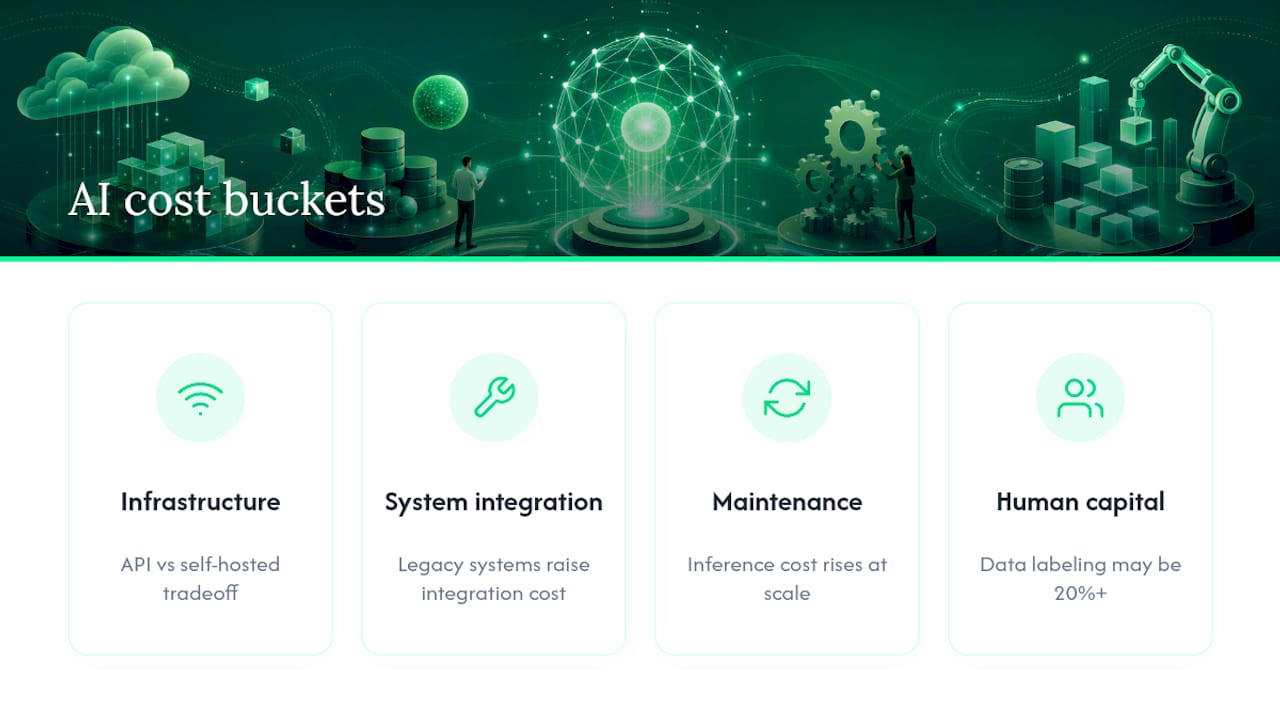
Data preparation and labeling is usually the most underestimated line item. If your data lives in clean, structured databases, preparation might take a few weeks. If it’s scattered across PDFs, scanned forms, or inconsistent spreadsheets, labeling and cleaning can consume 20% or more of the entire project budget before a single model gets trained.
Talent composition changes the math fast. A team of two mid-level engineers costs far less than a team anchored by a machine learning specialist and a compliance reviewer, but the cheaper team may also take twice as long or produce a less reliable system. Clutch’s pricing data shows wide variance in hourly rates by region and specialization, which is why two vendor quotes for “the same project” can differ by 3x.
Systems integration is where legacy infrastructure bites. Connecting a new AI feature to a modern CRM is straightforward. Connecting it to a 15-year-old mainframe or a homegrown database with no documented API is a different project entirely, and vendors often underquote this because they haven’t seen your systems yet.
Inference costs split into two models: pay-per-token API calls or self-hosted GPU infrastructure. API pricing scales with usage, which is fine at low volume but can become the largest recurring cost once you’re processing millions of requests a month. Self-hosting shifts that cost into fixed infrastructure, which only pays off past a certain volume threshold.
Compliance and security review adds cost proportional to how regulated your industry is. A marketing tool needs basic security review. A healthcare or financial system needs documented data lineage, audit trails, and often a formal conformity assessment, which is far cheaper to design in from day one than to retrofit later, as Netguru’s budget guide points out.

Pro Tip: Ask every vendor to break down their quote by these five categories before you compare proposals. A single lump-sum number hides which driver is actually eating your budget, and it’s the fastest way to spot a lowball quote that’s missing compliance or integration work entirely.
How Should You Split an AI Budget Across Project Phases?
A useful AI budget isn’t one number. It’s six smaller numbers, one for each phase of the build, and knowing the typical split lets you sanity-check any vendor proposal in about five minutes.
- Discovery (5 to 10% of budget). Scoping the problem, auditing available data, and defining success metrics. Skipping this phase is the single most common cause of scope creep later.
- Data preparation (20 to 25%). Cleaning, labeling, and structuring the data the model will actually learn from. This is almost always bigger than clients expect going in.
- Model development (roughly 15%). Selecting, training, or fine-tuning the model architecture. Ironically, this is often the smallest phase in a well-run project because so much of the real work happens upstream in data prep.
- Testing and validation (roughly 10%). Checking accuracy, bias, and edge cases before anything touches production.
- Deployment (roughly 15%). Integration with production systems, user interfaces, and rollout planning.
- Maintenance and iteration (25 to 30%). Ongoing monitoring, retraining, and fixes once the system is live, according to Netguru’s phase modeling.
Translate that into approximate figures and the pattern becomes clearer: for a mid-complexity project with a moderate budget, notable portions go to discovery, data preparation, model work, testing, deployment, and maintenance, with maintenance often being the largest share. Enterprise projects follow a similar distribution at larger scales.
Notice that maintenance is the largest single line in both cases. That’s the pattern most first-time AI buyers miss entirely.
Which Pricing Model Fits Your AI Project?
How you pay for AI work matters almost as much as what you’re paying for. The wrong contracting model can leave you either overpaying for certainty you didn’t need or under-protected against scope drift.
- Fixed price works well when requirements are locked and the scope is genuinely well-understood, like a straightforward integration or a defined feature build. It fits poorly with exploratory work, since AI projects often reveal new requirements once real data enters the picture, and fixed-price contracts leave no room to adjust.
- Time and materials or retainers shift the iteration risk onto a shared timeline rather than a fixed deliverable, which suits research-heavy or experimental phases where nobody can fully specify the end state upfront.
- Dedicated team arrangements offer the most control and institutional knowledge over time, at a steady monthly cost, but require enough ongoing work to justify keeping specialists on staff.
- In-house hiring makes sense for companies planning multiple AI initiatives over years, though ramp-up time and specialized salaries make it a slower path to a first working system.
- SaaS and API-first prototypes get you to a working proof of concept fastest and cheapest, letting you validate the idea before committing to a custom build.
Most experienced buyers start with the last option and graduate to a more custom, owned model once the value case is proven.
What Does It Cost to Run an AI System After Launch?
The build is the down payment. What you pay every month after launch is where budgets actually get tested, and it’s the part most first-time buyers forget to model.
Recurring costs typically include inference or API token spend, periodic retraining as data drifts, MLOps infrastructure to monitor model performance, data storage, human-in-the-loop reviewers for high-stakes decisions, and periodic compliance audits. None of these show up in a one-time build quote, and all of them recur indefinitely.
By the numbers: Multi-year total cost of ownership commonly runs 1.5 to 2 times the initial build cost once operating expenses accumulate over three years. A $150,000 build, in other words, can realistically demand $225,000 to $300,000 in cumulative spend by year three.
A reasonable way to model this: budget Year 1 operating costs at roughly 20 to 30% of build cost, since usage is still ramping and you’re catching early bugs. Years 2 and 3 often climb higher as usage scales and retraining cycles kick in, particularly for systems processing growing transaction volumes. The most common vendor trap here is a proposal that quotes build cost in bold and buries “ongoing hosting and support” in a footnote with no numbers attached. Ask for a specific Year 1, Year 2, and Year 3 operating estimate before you sign anything, not a vague reference to “minimal maintenance.”
How Do You Build a Realistic AI Budget Estimate?
Estimating AI costs well isn’t about finding the right calculator. It’s about forcing every stakeholder to agree on scope before pricing gets attached to it.
- Define the outcome, not the technology. “Reduce claims processing time by 40%” is a budget-able target. “Build an AI system” is not.
- Inventory your data and integrations. List every system the AI needs to read from or write to, and flag which ones lack modern APIs.
- Choose the architecture tier. Decide upfront whether this is an API-based prototype, a mid-complexity RAG build, or a custom enterprise system, since that decision drives every number after it.
- Estimate phase costs using the discovery-through-maintenance split above, adjusted for your architecture tier.
- Add operating cost bands for Years 1 through 3, not just build cost, using the TCO multiplier as a sanity check.
Before signing any vendor proposal, run through a short checklist: Who owns the data and the model weights when the contract ends? What’s the guaranteed response time (SLA) and p95 latency? What’s the forecasted monthly token or API spend at expected usage? How often will the model be retrained, and who pays for it? What compliance obligations apply, and who signs off on them?
Pro Tip: Build three numbers for every budget line: low, expected, and high. Agentic AI workflows in particular can show 10x swings in token spend between a quiet month and a heavy one, so a single-point estimate almost always turns out wrong in one direction or the other. Presenting a range instead of one number also makes your budget more credible to finance, not less.
AI-assisted estimation tools can also help here. According to BuildStackHub’s research on cost estimation accuracy across industries, AI-assisted estimators improve accuracy by roughly 17 to 22 percentage points compared to manual processes, largely because they force itemized line-item thinking instead of a single gut-feel number.
How Do You Measure ROI on an AI Investment?
The business case for AI stands or falls on how conservatively you model payback. Optimistic year-one savings projections are the most common way a good AI project ends up looking like a bad investment on paper.
- Track FTE hours saved on the specific task the AI now handles, converted to a dollar figure using loaded labor cost, not just base salary.
- Track error-cost avoidance, especially in regulated workflows where a mistake carries fines or rework cost, not just inconvenience.
- Track revenue enablement, such as faster quote turnaround or higher lead conversion, where AI removes a bottleneck rather than just cutting labor.
Calculate payback period against total cost, including the Year 2 and Year 3 operating costs covered earlier, not against build cost alone. A project that looks like it pays back in eight months against build cost might take fourteen months once realistic operating costs enter the model. Run the calculation at optimistic, expected, and conservative usage levels, and treat intangibles like improved decision consistency as supporting evidence, not as line items in the payback math itself.
How Can You Control AI Project Costs Without Cutting Corners?
Cost control in AI projects rarely means cutting scope. It usually means sequencing spend so you’re not paying for scale you haven’t validated yet.
- Prototype with an API or RAG setup before fine-tuning anything. Fine-tuning a custom model is expensive and often unnecessary until an API-based version has proven the concept works.
- Roll out in phases and gate features by usage tier, so you’re not building infrastructure sized for scale you don’t have yet.
- Optimize inference through caching repeated queries, batching requests, and using smaller or lower-precision models where accuracy allows, which directly cuts recurring token or compute spend.
- Use outsourced annotation and active learning for labeling work, letting the model flag uncertain cases for human review rather than having a team label everything from scratch.
Pro Tip: The cheapest place to cut cost is almost never the model itself, it’s the labeling pipeline. Active learning approaches, where the system prioritizes the data points it’s least confident about, can cut labeling volume substantially without touching accuracy, according to phased-engagement insights from DECODE’s cost analysis.
Why Compliance-First Budgeting Matters for Regulated Industries
Autonomousfirm specializes in building AI-native firms, providing both the technology and the team needed to turn domain expertise into scalable software rather than a rented tool subscription, as outlined on the Autonomousfirm platform. Such firms often focus on regulated sectors, including finance, healthcare, legal, and insurance, where automating a workflow means owning the complete system instead of licensing a black-box vendor product.
That distinction shapes the budget conversation directly. Building compliance, security, and audit trails into a system’s architecture from the discovery phase costs less than retrofitting them after a regulator or auditor flags a gap. This model may emphasize proprietary knowledge transfer, aiming for clients to keep control of their data and their system’s logic rather than depending on a third party’s roadmap, which can reduce operational costs over the system’s life rather than just at launch.
What I’ve Seen Go Wrong With AI Budgets
The costliest mistake I see isn’t a bad cost estimate. It’s a procurement process that locks in a fixed-price contract for work nobody has scoped yet, then discovers three months in that the data wasn’t clean, the legacy system had no API, and compliance review wasn’t included at all.
Regulated projects need governance decided before code gets written: who owns the model weights, who signs off on retraining, what the audit trail looks like. Skipping that step doesn’t save money, it just moves the cost to month eight, disguised as a change order. Building IP ownership and compliance design into the contract from day one is the cheapest insurance a budget can buy, cheaper by far than the conservative payback modeling that regulated buyers should already be running against every projected number.
— Matevz
Get a Compliance-Ready Cost Estimate Before You Commit
Most vendor quotes hand you a build price and leave the next three years of operating cost as your problem to discover later. Some companies build systems intended to be owned outright by the client, with compliance and security architecture designed in from discovery rather than bolted on after an audit finding.
That ownership model is what actually lowers total cost of ownership over time, because you’re not paying recurring license fees for a system you could have owned. For financial validation frameworks that pair well with this kind of planning, Amplify Consults’ efficiency and cost analysis tools offer a useful complement when building the internal business case. If you’re evaluating a regulated AI project and want a realistic low, expected, and high budget band before you talk to a vendor, start a discovery conversation with Autonomousfirm and get a costing session scoped to your actual data and compliance requirements.
Sources
- AI Implementation Cost vs ROI: Finding the Balance
- How much does AI development cost in 2026? | DECODE
FAQ
How Much Does an AI Project Cost?
Simple API-based features typically run $10,000 to $40,000, mid-complexity builds like RAG assistants run in the $40,000 to $120,000 range, and enterprise-grade custom systems frequently exceed $400,000, with total cost of ownership often reaching 1.5 to 2 times the build cost over three years.
What Is the 30% Rule in AI?
There’s no single standardized “30% rule” in AI budgeting; the figure varies by source, but a widely cited pattern reserves roughly 25 to 30% of total AI budget for ongoing maintenance and iteration after launch, rather than treating the build as a one-time expense.
Why Do So Many AI Projects Fail to Deliver Value?
AI projects commonly underdeliver when teams skip discovery and data-quality work, underestimate integration with legacy systems, or budget only for the build phase while ignoring the recurring operating costs, retraining, and monitoring, that determine long-term performance.
Who Is the Richest AI Founder?
Rankings shift with market valuations, and this article’s research doesn’t verify a specific current figure, but the wealthiest individuals tied to AI are typically founders or major shareholders of large AI infrastructure and chip companies rather than application-layer startups.
Should I Choose Fixed-Price or Time-and-Materials for an AI Project?
Fixed-price contracts fit well-scoped, well-understood work, while time-and-materials or retainer models suit exploratory AI projects where requirements are likely to shift once real data enters the picture.