Adopt AI for prior authorization selectively: let it handle routine, criteria-clear cases and evidence-gathering, and keep clinicians in charge of complex determinations. Done right, it cuts turnaround time and slashes missing-information denials. Done wrong, with no transparency into the decision logic, it increases inappropriate denials and patient harm. Start with a small, measurable pilot that logs every decision and routes anything ambiguous to a human.
TL;DR:
- AI improves first-pass approval rates and reduces paperwork time most effectively for routine, criteria-clear requests, often shortening turnaround times significantly.
- Automating complex, high-risk cases requires transparency, audit trails, and clinician oversight to prevent increased inappropriate denials and patient harm.
- Payer connectivity should employ a three-rail approach using FHIR APIs, RPA, and voice agents, with EHR write-back essential for maintaining workflow efficiency.
- Regulatory demands for explainability, auditability, and nondiscrimination testing mean organizations must build understandable policy logic and route high-risk cases to clinicians.
- Choosing between point solutions, end-to-end platforms, or custom-built systems depends on internal control needs and future scalability, with costs scaling accordingly.
Table of Contents
- How AI Is Used Across the Prior Authorization Workflow
- What Benefits Do Organizations Actually See?
- Risks, Harms, and the Regulatory Landscape
- Technical Architectures That Actually Work in Production
- Practical Implementation Checklist Before You Scale
- Getting Staff and Physicians to Actually Use It
- Ethical Considerations Beyond Bias: Privacy and Data Security
- Comparing AI Vendor Models for Prior Authorization
- Cost Considerations and Estimating Real ROI
- What’s Next for AI in Prior Authorization
- Publisher Perspective: Balancing Automation With Clinical Stewardship
- How Autonomousfirm Can Help You Build This the Right Way
- Sources
- FAQ
How AI Is Used Across the Prior Authorization Workflow
Prior authorization automation touches five distinct stages, and confusing them is why so many pilots underdeliver. Each stage has a different job, a different failure mode, and a different amount of acceptable AI autonomy.
Coverage discovery comes first. Automated Coverage Requirements Discovery (CRD) checks, often built on HL7 FHIR standards, tell staff up front whether a given service even needs prior authorization and pull real-time eligibility data before anyone starts building a case file.
Clinical document extraction is where most of the labor savings live. Clinical natural language processing (CNLP) tools scan progress notes, lab results, and imaging reports to pull out the specific data points a payer’s policy requires, instead of a nurse manually hunting through a chart.
Gap detection follows immediately. The system compares what’s been extracted against the payer’s specific criteria and flags what’s missing, then assembles a submission packet tailored to that payer’s format rather than a generic template.
Submission happens through whichever channel the payer actually supports:
- FHIR-based APIs for payers with modern integration capability
- Robotic process automation (RPA) that navigates legacy payer web portals the way a person would
- AI voice agents that call into interactive voice response systems or speak directly with a live payer representative
Status tracking and write-back close the loop. The system monitors for a determination, then pushes the authorization number and outcome back into the EHR so the care team sees it in their normal workflow, not in a separate dashboard nobody checks.
What Benefits Do Organizations Actually See?
The honest answer: real, measurable gains in the paperwork stage, and mixed results anywhere clinical judgment gets automated away, highlighting the importance of how to document drug testing procedures for compliance. Organizations running prior authorization automation typically track four numbers.
- Turnaround time from submission to determination, which shortens most reliably for routine, criteria-clear requests
- First-pass approval rate, which improves when automation catches missing documentation before submission instead of after a denial
- Denial and appeal volume, which trends down for administrative denials but requires careful tracking to make sure clinical denials aren’t quietly rising
- Staff hours saved, measured in time no longer spent on manual chart review, portal data entry, and phone holds
Public-payer data offers a useful reality check on how far this has come. MACPAC’s review of automation in Medicaid prior authorization documents states and managed care organizations increasingly layering AI-assisted tools onto legacy PA systems, alongside the operational friction of doing so across fragmented state Medicaid IT environments. Academic analysis backs up the upside on the clinical side too: a peer-reviewed review of AI approaches to prior authorization found AI can standardize the initial review pass and improve consistency across similar cases, while flagging that complex or borderline cases still need a clinician’s judgment call.
The caveat that matters most when you’re reading vendor pitches: payer mix and specialty change everything. A pilot in primary care referral management will show different numbers than one in oncology drug authorization, because the underlying criteria complexity is not remotely comparable. Set your own baseline before you start, using your organization’s actual denial rate and turnaround time, not an industry average pulled from someone else’s case study.
Risks, Harms, and the Regulatory Landscape
The single biggest risk in this space isn’t AI itself. It’s AI making high-stakes denial decisions with no visibility into why. The AMA has documented cases where automated systems, applied without adequate transparency or clinician oversight, contributed to more prior authorization denials and put patients at risk of delayed or denied care. That’s not an argument against automation. It’s an argument against opaque automation.

Regulators are responding on two fronts. Federally, CMS-0057-F requires impacted payers to build FHIR-based prior authorization APIs and publish decision turnaround metrics, pushing the industry toward the interoperable, auditable infrastructure that AI needs to work safely in the first place. KFF’s policy review of AI in prior authorization and claims review tracks a growing wave of state-level rules aimed at a specific problem: AI reducing the amount of genuine human review behind a denial, with real gaps in consumer protection when that happens. At the federal policy level, the White House’s National Policy Framework for Artificial Intelligence calls out transparency, auditability, and nondiscrimination testing as baseline requirements for AI systems making consequential decisions, prior authorization included.
What this means in practice for any organization scaling past a pilot:
- Every automated determination needs a human-readable explanation of the policy logic behind it, not a confidence score
- Complex, high-risk, or borderline cases route to a clinician by default, never by exception
- Full audit trails capture what data went in, what logic applied, and who (or what) made the final call
- Nondiscrimination testing checks whether denial rates vary in ways that track with protected characteristics rather than clinical need
Pro Tip: If a vendor can’t show you the actual rule or policy logic behind a specific automated denial, in plain language, that’s a governance gap you’ll own once you deploy it, not theirs.
Technical Architectures That Actually Work in Production
The uncomfortable truth about payer connectivity: no single integration method reaches every payer, and waiting for universal FHIR adoption means waiting years. The pragmatic pattern is a three-rail architecture that hits every payer through whichever channel they actually support.
- FHIR APIs handle payers with modern CMS-0057-F-aligned infrastructure, giving structured, real-time data exchange with the least manual overhead
- RPA covers payers still running legacy web portals, automating the same click-and-type workflow a staff member would otherwise do by hand
- AI voice agents manage phone-based interactions for payers that still require a call, whether that’s navigating an IVR tree or speaking with a live representative
Skipping any one rail just shifts automated volume back onto staff, which is exactly the fragmented-payer-API problem this pattern exists to solve.
EHR write-back is the piece that gets underestimated most often. If the authorization number, status, and determination don’t land back inside the clinician’s normal EHR workflow, staff end up duplicating work by checking a separate portal or dashboard, and the efficiency gain evaporates. A system that automates submission beautifully but forces a manual status check every day hasn’t actually saved anyone time.
Data governance underpins all of it: encrypted data at rest and in transit, role-based access controls, and logging detailed enough to reconstruct any decision for an audit. Most organizations roll this out in phases: pilot one payer connection and one specialty, expand the FHIR rail as more payers hit their CMS-0057-F deadlines, then layer in RPA and voice coverage for the stragglers.
Practical Implementation Checklist Before You Scale
Before signing anything, walk through readiness, governance, integration, and pilot design in that order. Skipping ahead to vendor selection before you’ve mapped your own payer mix is the most common reason pilots stall.
- Readiness: Map which payers require prior authorization for your top procedure and specialty volumes, confirm EHR API access, and pull a sample of real records (de-identified) for testing against actual documentation quality.
- Governance: Define which case types clinicians must review regardless of AI confidence, build an escalation path for disputed determinations, and commit to periodic bias testing on denial patterns.
- Integration: Confirm which payers support FHIR today, which need RPA, and which need voice coverage; verify write-back capability into your EHR; and set up single sign-on and centralized logging from day one.
- Pilot design: Scope one specialty or payer relationship, set explicit KPIs (turnaround time, first-pass approval, denial rate by category), define a realistic sample size, set a timeframe of 90 to 180 days, and name an accountable owner for each workflow stage.
- Procurement questions: Ask directly who owns the data and the resulting IP, what the deployment model is (cloud, private cloud, on-premises), what the SLA guarantees for uptime and support, and what compliance certifications (HIPAA, SOC 2, ISO 27001) the vendor actually holds versus claims to be working toward.
Pro Tip: Ask every vendor to show you one denial their system generated and walk through the exact policy logic behind it. If they can only show you a score, keep looking.
Getting Staff and Physicians to Actually Use It
The best prior authorization automation in the world fails if the utilization review nurse routes around it because she doesn’t trust it, or the ordering physician ignores its recommendations because nobody explained how it works. Change management here isn’t a soft add-on. It’s the difference between a pilot that generates real numbers and one that generates workaround habits.
Start training with the staff who touch prior authorization daily, not with an all-hands rollout. Utilization review nurses and prior auth coordinators need hands-on time with the actual interface, using their own real (de-identified) cases, before go-live. Show them exactly what the system automates and what it still routes to them, because vague promises about “AI handling the busywork” breed suspicion fast when a case gets stuck.
Physician buy-in requires a different pitch: less time explaining the technology, more time showing that it reduces their administrative burden without overriding their clinical judgment on anything but the most routine cases. Physicians who’ve been burned by opaque payer denials in the past are rightly skeptical of any system that looks like more of the same. Walking through the audit trail and override process, up front, addresses that skepticism directly.
Build a feedback loop from week one: a simple channel for staff to flag when the system got something wrong, reviewed weekly during the pilot. That loop does double duty. It catches genuine errors fast, and it gives skeptical staff visible proof that their input actually changes the system, which is usually what converts a reluctant user into an advocate.
Ethical Considerations Beyond Bias: Privacy and Data Security
Bias testing gets most of the attention in AI ethics discussions, and it deserves it, but patient privacy and data security carry equal weight in a prior authorization context specifically because the data involved is uniquely sensitive: diagnoses, treatment history, mental health records, substance use history, all flowing through a third-party system to justify a payer decision.
Every automation layer that touches protected health information needs to answer a basic question: where does the data actually go, and who can see it? A CNLP tool extracting lab values from a chart note is processing full clinical narrative text, not just structured fields, which means it’s exposed to far more sensitive detail than the specific data point it’s extracting. That expanded exposure needs the same encryption, access logging, and minimum-necessary handling as any other PHI touchpoint, not a lighter standard because “it’s just for automation.”
Data residency and deployment model matter more here than in most healthcare IT decisions. A cloud-hosted, multi-tenant AI model trained across many client organizations raises a different risk profile than one deployed privately with data that never leaves an organization’s own environment. Ask specifically whether patient data is used to train shared models across other clients, because that’s a meaningfully different privacy posture than a system that processes data in isolation.
Consent and transparency toward patients matter too, even though they’re rarely discussed. A patient whose care is being delayed by an AI-influenced denial has a reasonable expectation of knowing that, and organizations that get ahead of this with clear notice policies avoid a much harder conversation later.
Comparing AI Vendor Models for Prior Authorization
Vendors in this space generally fall into three structural categories, and the differences matter more than any feature checklist.
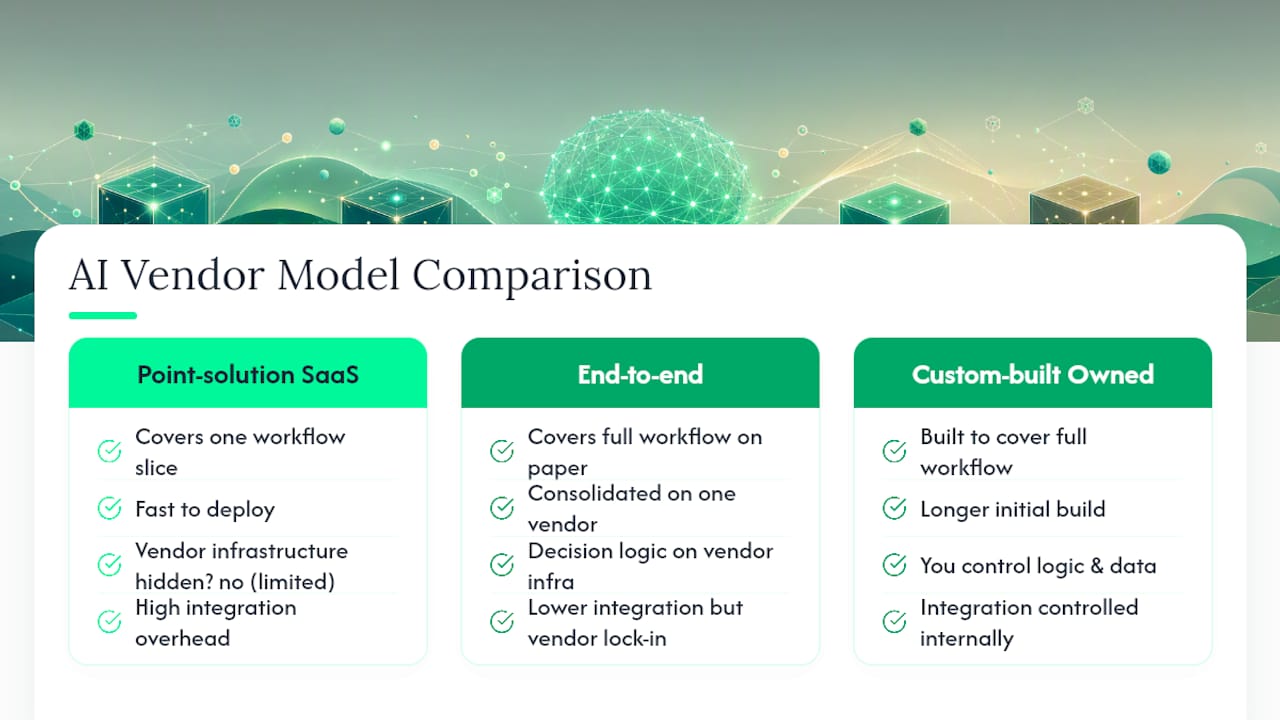
Point-solution SaaS tools handle one slice of the workflow, usually document extraction or a single payer’s submission channel, licensed as a subscription. They’re fast to deploy and cheap to start, but stitching several together to cover a full workflow creates integration overhead and multiple vendor relationships to manage.
End-to-end platforms promise to cover intake through status tracking in one system. That consolidation is appealing on paper, but it usually means renting a black box: the underlying decision logic and the data pipeline both live on the vendor’s infrastructure, and switching vendors later means starting over.
Custom-built, owned systems trade a longer initial build for permanent control over the logic, the data, and the integration architecture. This model fits organizations that plan to scale automation across multiple departments over time and want the compliance and audit trail built to their own specifications rather than a vendor’s generic template.
The right choice depends less on price and more on a single question: does your organization want to rent a workflow, or own the system that runs it? Organizations handling complex specialty authorizations, high payer volume, or strict internal compliance requirements tend to outgrow rented point solutions within a couple of years and end up rebuilding anyway.
Cost Considerations and Estimating Real ROI
Initial investment varies enormously depending on the model. Point-solution SaaS tools typically run lowest upfront, priced per seat or per transaction, but costs scale with volume in ways that can surprise finance teams once usage climbs. End-to-end platforms carry higher licensing costs plus implementation fees for EHR integration. Custom builds require the largest upfront investment, covering integration engineering, compliance architecture, and testing, but carry no ongoing per-transaction licensing cost once deployed.
Ongoing operational costs go beyond the software bill. Budget for continued staff training as the system evolves, periodic bias and accuracy audits, compliance reviews tied to changing state and federal rules, and a dedicated internal owner who monitors performance rather than assuming a “set and forget” deployment.
ROI estimation should center on the metrics from your pilot, not vendor projections. Multiply your baseline staff-hours-per-authorization by your fully loaded labor cost, then compare against the hours actually saved once automation handles the routine cases. Factor in the financial impact of faster turnaround, since delayed care and delayed billing both carry real costs beyond staff time. Weigh that combined savings against total cost of ownership over a three-to-five-year horizon, not just year one, because rented platforms carry compounding subscription costs that owned systems avoid after the initial build.
What’s Next for AI in Prior Authorization
The clearest trend already in motion is regulatory: as more payers hit their CMS-0057-F FHIR API deadlines, the fragmented-portal problem that forces organizations to lean on RPA and voice agents will shrink, though probably not disappear for years given how uneven payer technology adoption has been historically.
Expect explainability requirements to tighten further, not loosen. The direction of travel across federal and state policy is toward mandatory transparency and auditability for any AI system influencing a coverage decision, which favors organizations that built policy-aligned, explainable logic from the start over those running opaque predictive models.
Clinical NLP will keep getting better at parsing unstructured notes, narrowing the gap between what a human reviewer catches in a chart and what an automated system extracts. That should push first-pass approval rates higher industry-wide, provided the accuracy gains get validated rather than assumed.
The organizations that come out ahead won’t necessarily be the ones that automated first. They’ll be the ones that built systems clinicians actually trust, with audit trails regulators can actually inspect, on infrastructure the organization actually owns.
Publisher Perspective: Balancing Automation With Clinical Stewardship
The industry’s default instinct is to buy a black box that spits out a decision. That’s backwards. A prior authorization system should show its work: the specific policy clause, the specific data point, the specific reason a case routed to a human. Anything less isn’t automation, it’s liability with a nicer interface.
The deeper issue is ownership. Organizations renting a vendor’s opaque logic have no real ability to audit it, retrain it, or prove to a regulator how a given decision got made. Owning the stack, the data, and the audit trail isn’t a technical preference. It’s what lets a health system stand behind its own decisions when a state regulator or an angry physician asks how a denial happened.
— Matevz
How Autonomousfirm Can Help You Build This the Right Way
Most vendors in this space sell you a subscription to their black box. Autonomousfirm builds you the system instead, one your organization owns outright, with the audit trail and policy logic visible from day one instead of hidden behind a vendor’s proprietary wall.
Two paths fit prior authorization automation specifically. Partnership mode pairs your clinical and operational expertise with an embedded engineering team to co-build a custom system around your actual payer mix and denial patterns, not a generic template. Venture mode goes further for organizations ready to productize what they build into a standalone platform. Both run on Autonomousfirm’s Compliance OS approach: private, self-hosted deployment so patient data never leaves your control, built by a team with regulated-industry background across ISO 27001, pharma, and finance environments where getting AI governance wrong isn’t an option. For teams evaluating whether a fully custom build makes sense before committing, the AI OS platform overview breaks down how the underlying automation architecture maps to regulated workflows like prior authorization.
If you’re weighing a rented point solution against something built to your own compliance standards, reach out to Autonomousfirm for a pilot scope and capability assessment before you sign a multi-year vendor contract you can’t audit.
This article is general information, not a substitute for advice from a qualified doctor. Consult a qualified healthcare professional about your own circumstances before acting on anything here.
Sources
- AMA: How AI is leading to more prior authorization denials / prior authorization coverage
- MACPAC: Automation in the prior authorization process
- Could an artificial intelligence approach to prior authorization be more human? (PMC)
- White House: National Policy Framework for Artificial Intelligence (legislative recommendations)
FAQ
What does AI actually mean for prior authorization?
It means routine, criteria-clear cases get checked, documented, and submitted faster, with fewer denials caused by missing paperwork. It does not mean an algorithm should make final coverage decisions on complex cases without a clinician reviewing the reasoning behind it.
Is it true that AI is denying more healthcare claims?
There’s real evidence behind this concern: the AMA has documented cases where automated systems, deployed without adequate transparency or oversight, contributed to increased denials and put patients at risk. The fix isn’t avoiding AI, it’s requiring explainable logic, audit trails, and mandatory clinician review on anything beyond routine, low-risk cases.
What’s the difference between precertification and prior authorization?
The terms are used interchangeably by most payers and providers, both referring to the requirement that a payer approve a service before it happens or before it’s covered. Some organizations use “precertification” specifically for inpatient admissions and “prior authorization” for outpatient services or medications, but there’s no universal, standardized distinction across the industry.
How do you explain prior authorization to a patient?
Tell them their insurance company requires approval before covering a specific treatment, test, or medication, and that the wait is coming from the payer’s review process, not from their care team dragging their feet. If AI is involved in gathering or submitting the request, it’s worth noting that a clinician still reviews anything beyond the most routine, clear-cut approvals.
How much does AI prior authorization software cost?
Costs vary widely by vendor model, from per-seat SaaS subscriptions to full custom builds, and Autonomousfirm doesn’t publish fixed pricing since each engagement is scoped to the organization’s payer mix and integration needs. Current details on partnership and build options are available directly on the Autonomousfirm site.