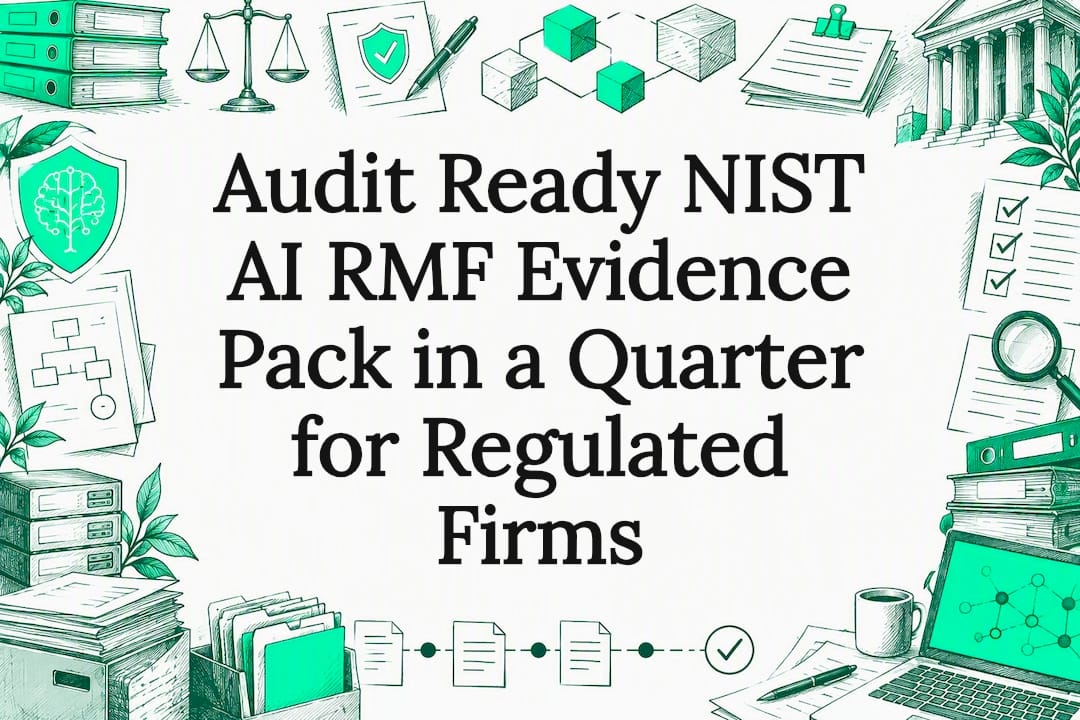
The NIST AI Risk Management Framework (AI RMF) is a voluntary, lifecycle approach organized into four functions, GOVERN, MAP, MEASURE, and MANAGE, that helps organizations build and operate AI systems that are more trustworthy and auditable. It’s meant for anyone deploying or overseeing AI, from risk teams to engineers. The payoff: a defensible paper trail showing you understood the risks and managed them on purpose, not by accident.
TL;DR:
- Most organizations should first inventory all AI systems and clearly define their intended use before developing testing and monitoring processes.
- Building a sector-specific profile, tailored to the company’s context, helps operationalize the AI RMF’s abstract framework into practical steps.
- Compliance efforts are strengthened when organizations retain versioned evaluation records, incident logs, and evidence demonstrating control over AI risks.
- Implementing governance as an ongoing, cross-cutting function ensures policies, approvals, and accountability are integrated into each phase of AI system lifecycle management.
- Partnering with vendors who can produce an auditable evidence pack from the start speeds up compliance and reduces the risk of stalled or incomplete deployment.
Table of Contents
- Why NIST Built the AI RMF and Where It Applies
- AI RMF Core Explained: Govern, Map, Measure, Manage
- The NIST Implementation Ecosystem: Profiles, Playbook, and Crosswalks
- How Do You Implement the AI RMF Step by Step?
- What Belongs in a Defensible AI Risk Evidence Pack?
- Aligning AI RMF With ISO and Other Compliance Programs
- Who Owns What: Roles, Documentation, and Monitoring Cadence
- Tracking NIST Updates and Framework Versions Over Time
- What AutonomousFirm.ai Has Learned Building NIST-Aligned Systems
- Why Most AI RMF Rollouts Stall Before They Start
- Build a NIST-Aligned AI System With a Technical Partner
- Sources
- FAQ
Why NIST Built the AI RMF and Where It Applies
NIST published AI RMF 1.0 as a voluntary framework, not a regulation, and deliberately left it non-sector-specific so a hospital system, a bank, and a logistics company can all use the same vocabulary to talk about AI risk. That was the point of pulling in more than 240 contributing organizations over roughly a year and a half: build something specific industries could adapt rather than something one industry could claim as its own.
The framework treats AI risk as a lifecycle problem, not a one-time checkpoint. Risk shows up at data collection, at model training, at deployment, and again months later when the world the model was trained on shifts underneath it. NIST’s guidance is explicit that risks come from more than the model itself: data quality, deployment context, and the humans making judgment calls downstream all factor in. That socio-technical framing is why a NIST AI risk assessment framework can’t just be a model audit. It has to look at the whole system.
NIST anchors the entire framework around seven characteristics of trustworthy AI. A system that’s missing more than one or two of these is a liability waiting to surface:
- Valid and reliable: performs as intended under expected conditions, with documented limits
- Safe: doesn’t create physical, psychological, or operational harm
- Secure and resilient: withstands adversarial manipulation and degrades gracefully
- Accountable and transparent: someone owns the outcome, and decisions can be traced
- Explainable and interpretable: people affected by a decision can understand roughly why it happened
- Privacy-enhanced: minimizes unnecessary data exposure
- Fair, with harmful bias managed: outcomes don’t systematically disadvantage protected groups
No system maximizes all seven at once. A highly explainable model might sacrifice some accuracy; a highly secure system might be less transparent about its internals. The framework’s real value is forcing an organization to name the trade-offs it’s making instead of pretending they don’t exist.
Who should actually use this? Any team building, buying, or deploying AI where a bad outcome has consequences, financial, legal, reputational, or physical. That includes compliance officers who need a common language with engineers, procurement teams evaluating a vendor’s model, and legal counsel trying to figure out what “reasonable AI governance” looks like before a regulator or plaintiff’s attorney asks.
AI RMF Core Explained: Govern, Map, Measure, Manage
The AI RMF Core breaks the work into four functions. They’re not a waterfall, and NIST is explicit that these are not meant to run as a rigid checklist executed once and filed away.
GOVERN sets the rules of the game before anything else happens. It covers policies, accountability structures, risk tolerance, and who has authority to approve or kill an AI use case. In practice, GOVERN looks like a committee that reviews new AI proposals, a documented risk appetite statement, and clear escalation paths when something goes wrong. Skip this function and everything downstream becomes ad hoc.
MAP is where you figure out what you’re actually building and where it can hurt someone. This means documenting intended use, out-of-scope use, affected stakeholders, and every component in the system, including third-party models and purchased data you didn’t build yourself. A hiring tool’s MAP exercise should flag that rejected candidates are a stakeholder group whose harm needs consideration, not just the recruiters using the dashboard.
MEASURE is testing and analysis: accuracy benchmarks, fairness metrics across demographic groups, red-teaming for adversarial inputs, and ongoing performance tracking after launch. This is the function most teams jump to first, and it’s usually a mistake.
MANAGE is where you act on what MEASURE found: allocate resources to fix known issues, decide whether residual risk is acceptable, and build the response plan for when (not if) something breaks in production.
- GOVERN: policy, accountability, approval authority
- MAP: intended use, stakeholders, system inventory
- MEASURE: testing, metrics, monitoring design
- MANAGE: risk treatment, resource allocation, incident response
Here’s the part most implementation guides gloss over: GOVERN doesn’t sit quietly in a box waiting its turn. It runs underneath the other three functions the entire time. GOVERN is cross-cutting by design: testing alone can’t substitute for missing authority, unclear intended-use documentation, or a vendor contract with no accountability clause.
The iterative nature matters more than the labels. A production incident discovered through MANAGE should trigger a return trip to MAP to ask whether the original intended-use statement missed something. A new regulatory requirement should trigger a GOVERN update that ripples into MEASURE, changing what you now have to test for.
Pro Tip: Treat the four functions as a loop with GOVERN as the hub, not four sequential boxes on a project plan. If your MEASURE phase turns up a surprise, your first move should be back to MAP, not straight into MANAGE.
The NIST Implementation Ecosystem: Profiles, Playbook, and Crosswalks
The AI RMF Core is deliberately abstract, which is exactly why NIST built companion resources to make it usable. Three matter most.
AI RMF Profiles translate the generic Core into something specific to a technology, sector, or use case. Profiles are tailored implementations of the same functions and subcategories, adjusted for a particular context. NIST points to examples like a generative AI profile, a hiring-technology profile, and a fair-housing profile, and it doesn’t hand down a single required template for any of them. A hospital building a diagnostic-support tool and an insurer building a claims-triage model both use the same four-function Core, but their profiles will name completely different stakeholders, risk thresholds, and required evidence.

The AI RMF Playbook exists to answer the question every team asks after reading the Core once: “Okay, but what do I actually do?” The Playbook maps suggested actions to specific AI RMF subcategories, things like documenting model limitations, establishing feedback channels for affected users, and defining thresholds that trigger human review. It’s the closest thing NIST offers to a task list, organized so a team can pull the subset relevant to their profile instead of working through the entire document cover to cover.
Crosswalks map AI RMF subcategories to other frameworks and regulatory schemes, useful when an organization is already operating under ISO/IEC standards or a sector-specific compliance regime and doesn’t want to build governance twice. But NIST is direct about the limits here: inclusion in a crosswalk doesn’t imply endorsement or full equivalence between the two frameworks. A control that satisfies one framework’s subcategory on paper may still leave an evidentiary gap against the other’s actual requirements.
- Profiles: sector or use-case tailoring of the Core, no fixed template
- Playbook: subcategory-level suggested actions and practical tasks
- Crosswalks: mapping to other standards, without claiming equivalence
Used together, these three turn a 40-page conceptual document into something a compliance team can actually operationalize inside a quarter, rather than a framework that sits in a binder.
How Do You Implement the AI RMF Step by Step?
Most teams that stall out on AI RMF implementation make the same mistake: they start with MEASURE, building test suites and fairness dashboards before anyone has written down what the system is supposed to do. Metrics without a documented intended-use statement have nowhere stable to attach their interpretation, so a 94% accuracy score means nothing if nobody defined what “acceptable” looks like for this specific use case.
Here’s a sequence that avoids that trap:
- Inventory every AI system and name an owner. Include purchased tools and embedded models inside vendor software, not just systems your engineers built. If nobody can answer “who owns this,” that’s your first finding.
- Write an intended-use and out-of-scope statement for each system. Be specific: “used to rank loan applications for underwriter review” is not the same risk profile as “used to auto-approve loans under $5,000.”
- Define risk appetite and set approval gates. Decide in advance what triggers a required human sign-off, a legal review, or an outright block, before a live incident forces the decision under pressure.
- Select measurable tests and monitoring signals tied to that intended use. Accuracy alone rarely tells the full story. Fairness metrics across subgroups, drift detection, and adversarial robustness checks usually matter more for anything customer-facing.
- Record residual risk and the treatment decision. Every system will have some risk left over after mitigation. Document what remains and who accepted it, by name.
- Build continuous monitoring and an incident review process. A model that passed testing in Q1 can degrade by Q3 as real-world data drifts from training data.
MAP deserves more scrutiny than most teams give it. Assessing all system components means looking past the foundation model or purchased application to the data pipelines and third-party integrations feeding it, and it means procurement contracts should include a documented exit plan in case the vendor relationship needs to end abruptly.
Pro Tip: If a team can’t produce a one-paragraph intended-use statement for an AI system in under five minutes, that system isn’t ready for a MEASURE phase yet. Send it back to MAP.
What Belongs in a Defensible AI Risk Evidence Pack?
An evidence pack is what stands between “we take AI risk seriously” and actually proving it to an auditor, a regulator, or a plaintiff’s attorney. NIST’s guidance ties each material AI use case to a specific set of artifacts, not a vague governance narrative.
A complete pack per system should include:
- A named owner and an intended-use statement, including explicit out-of-scope uses
- A full system and data inventory, covering third-party and embedded components
- A stakeholder and impact assessment identifying who could be harmed and how
- Evaluation results (accuracy, fairness, robustness) with dates and versions attached
- A monitoring plan describing what gets tracked post-deployment and how often
- Incident logs and escalation records for anything that went wrong
- Vendor and third-party assessments for any purchased or embedded AI component
- Approval records showing who signed off and under what risk appetite
- Documented residual-risk decisions, with the name of who accepted them
One detail trips up more teams than any other: a monitoring dashboard is not evidence. Dashboards show current state; they don’t preserve history. Retain versioned evaluation data, reviewer decisions, incident records, and configuration identifiers so the system remains auditable after it’s been updated or retired. A dashboard that resets or overwrites last quarter’s numbers gives you nothing to show an auditor asking what the system looked like six months ago.
Version everything. If your fairness test ran against model version 3.2 but the system in production today is 3.7, that gap is exactly what an examiner will ask about first.
Aligning AI RMF With ISO and Other Compliance Programs
Organizations already running ISO/IEC 27001 or similar management systems don’t need to build AI governance from scratch. Crosswalks exist specifically to connect AI RMF subcategories to frameworks like ISO/IEC 23894:2023 and ISO 31000, letting a risk team reuse existing documentation structures instead of duplicating effort.
The trap is treating a crosswalk as a substitute for verification. A control that maps cleanly to an ISO subcategory on paper might still leave gaps in scope, evidence quality, or residual risk that the mapping doesn’t surface. Three things to check before trusting a mapped control:
- Scope: does the ISO control cover the same system boundary as the AI RMF subcategory, or a narrower slice of it?
- Evidence: is the documentation that satisfies ISO actually detailed enough to satisfy an AI RMF auditor asking a different question?
- Residual gaps: what does the AI RMF subcategory require that the mapped ISO control simply doesn’t address?
For organizations in regulated industries, healthcare, finance, insurance, the practical approach is to run AI RMF alongside existing legal obligations rather than instead of them. AI RMF gives you the risk-management vocabulary and lifecycle structure; sector-specific law (HIPAA, GLBA, state AI statutes) gives you the enforceable floor. Neither one replaces the other, and a crosswalk is a starting point for that conversation, not the final answer.
Who Owns What: Roles, Documentation, and Monitoring Cadence
AI RMF implementation fails most often not from lack of technical skill but from unclear ownership. Someone needs to own each function, and “the AI team” is not an acceptable answer on an audit trail.
A workable role matrix looks roughly like this:
| Role | Primary responsibility |
|---|---|
| Executive leadership | Sets risk appetite, approves high-risk use cases |
| Risk/compliance owner | Maintains the inventory, tracks approval gates, owns the evidence pack |
| Technical owner (engineering/data science) | Builds tests, runs MEASURE activities, implements monitoring |
| Legal counsel | Reviews regulatory exposure, contract terms, incident response obligations |
| Procurement | Evaluates vendor AI claims, negotiates exit clauses, tracks third-party assessments |
Documentation standards matter as much as who holds the pen. Every material decision, a risk acceptance, a test result, an approval, needs a version number, a date, and a named approver. Review cadence should be explicit: quarterly for high-risk systems, annually at minimum for lower-risk ones, and immediately after any material change to the model, the data pipeline, or the regulatory environment it operates in.
Monitoring itself splits into two categories that get confused constantly. Testing, evaluation, verification, and validation (TEVV) activities happen before and periodically after deployment, they’re structured, scheduled, and produce artifacts. Dashboards, by contrast, show live operational state and are useful for day-to-day management but don’t substitute for the versioned records an auditor needs. Keep both, and don’t let the dashboard’s real-time convenience replace the archived evidence trail.
Incident response deserves its own documented procedure: who gets notified, what triggers a system pause, and how findings feed back into MAP for the next review cycle.
Pro Tip: Assign one person as the “AI risk registrar” whose sole job is keeping the inventory and evidence pack current. Distributed ownership across five busy people usually means nobody actually updates it.
Tracking NIST Updates and Framework Versions Over Time
AI RMF 1.0 isn’t a document you read once and shelve. NIST built it as a living framework, using a two-number versioning system to distinguish major structural updates from minor clarifications, and it expects organizations to track which version they’re operating against.
The Playbook updates more often than the Core document itself, since suggested actions and practical guidance evolve faster than the underlying risk taxonomy. NIST accepts public comments on the framework directly through AIframework@nist.gov, which means the guidance genuinely shifts based on practitioner feedback, not just internal NIST research.
For your own governance records, log three things every time you touch an AI RMF profile: which framework version you built against, what assumptions were baked into that build, and when the next scheduled review is due. Set a recurring calendar reminder to check NIST’s AI Resource Center for version changes rather than assuming a document you downloaded two years ago still reflects current guidance.
What AutonomousFirm.ai Has Learned Building NIST-Aligned Systems
Building AI systems for regulated industries surfaces the same lesson repeatedly: evidence has to be architected into the system from day one, not bolted on before an audit. When building a custom AI-native platform for a client in finance or healthcare, governance artifacts, intended-use documentation, approval logs, versioned evaluation records, can be generated as a byproduct of how the system runs, not as a separate compliance project someone has to remember to do later.
That approach comes from a team background in regulated environments where getting AI governance wrong isn’t a theoretical risk. Some firms build with private, self-hosted large language model deployment, so client data doesn’t leave the client’s control, a detail that matters enormously once MAP forces you to document exactly where sensitive data travels and who can access it.
Organizations working with any technical partner on NIST-aligned systems should expect the partner to help produce the inventory, the intended-use statements, and the monitoring plan as deliverables, not as an afterthought bolted onto a finished product. If a vendor can’t show you what their evidence pack looks like before the contract is signed, that’s a signal worth investigating.
Why Most AI RMF Rollouts Stall Before They Start
The single most common failure I see in AI RMF adoption isn’t a lack of ambition, it’s sequencing. Teams get excited about MEASURE because it produces numbers, dashboards, and something to show leadership. But metrics without a MAP phase behind them are just numbers looking for a home. Write the intended-use statement first. Everything else gets easier once that’s nailed down.
The second failure is over-engineering the Profile. A 60-page governance document that tries to cover every conceivable AI use case in the organization at once tends to collect dust. A tight, operational profile scoped to one workflow, with real owners and real thresholds, gets used because it’s actually usable.
Pilot one system end to end before scaling the process across the portfolio. You’ll find the gaps in your own process faster on one system than on twenty at once.
— Matevz
Build a NIST-Aligned AI System With a Technical Partner
Reading the framework is one thing. Building a system that generates the evidence pack automatically, instead of forcing your team to reconstruct it after the fact, is another. Autonomousfirm exists for organizations that would rather own a NIST-aligned AI system outright than rent a generic compliance tool that only checks boxes on the surface.

An engagement typically starts with discovery: mapping your current AI systems, documenting intended use, and identifying where your existing governance already covers AI RMF subcategories versus where gaps exist. From there, Autonomousfirm helps build the actual profile mapping and pilot system, often through the AI OS platform layer, so evaluation results, approval records, and monitoring signals get captured as the system runs rather than assembled manually before an audit. For organizations in healthcare specifically, deployments modeled on domain-specific AI layers, similar to how Panora approaches clinical AI in longevity and functional medicine, show how sector context changes what the evidence pack needs to contain.
If your organization needs a partner to turn NIST guidance into a working, auditable system rather than another binder on a shelf, start a conversation with Autonomousfirm about what a pilot engagement would look like for your first use case.
FAQ
What Are the NIST Guidelines for Managing AI Risks?
NIST’s guidelines center on the AI RMF Core, four functions, GOVERN, MAP, MEASURE, and MANAGE, that walk an organization from setting policy through inventorying systems, testing them, and managing residual risk. The full framework is voluntary and applies across sectors rather than prescribing a fixed set of technical controls.
Can You Explain the NIST AI Risk Management Framework (AI RMF)?
The AI RMF is a lifecycle framework that helps organizations identify, assess, and manage risks tied to AI systems using four connected functions rather than a one-time checklist. GOVERN operates as a cross-cutting function that runs underneath MAP, MEASURE, and MANAGE throughout a system’s life.
How Is AI Used in Risk Management?
AI itself increasingly supports risk management tasks, flagging anomalies, automating parts of monitoring, and speeding up claims denial management AI workflows in insurance and healthcare settings. But the NIST AI RMF governs the reverse relationship too: how organizations manage the risks that AI systems themselves introduce, which is the framework’s actual focus.
What Is the NIST AI Risk Management Framework (AI RMF) Best Described As?
It’s best described as a voluntary, non-regulatory framework that gives organizations a common structure and vocabulary for managing AI risk across its lifecycle, rather than a certification, a legal standard, or a fixed technical checklist. Companion resources like the Playbook and Profiles let each organization tailor that structure to its own sector and use case.
How Does a Business Actually Start Implementing the AI RMF?
Start by inventorying every AI system in use, including embedded and vendor tools, and writing a specific intended-use statement for each one before building any tests. That sequencing, MAP before MEASURE, is what separates AI RMF implementations that stick from ones that produce paperwork nobody trusts.